
Shopping Is Now a Top Use Case for Generative AI
This shift is no longer a prediction. Usage drives it.
According to recent research from The Economist, AI has become the new foundation of digital traffic, reshaping the entire discover–evaluate–decide journey for consumers:
- 70%+ of users rely on AI for information retrieval
- 50%+ depend on AI for shopping decisions
Usage patterns reinforce this change. Shopping-related queries now rank as the second most common use case for generative AI tools in the United States, surpassed only by general research and ranking ahead of writing assistance, planning, and coding. These patterns show that consumers do not treat AI as a secondary tool—they use it as a primary decision-making interface.
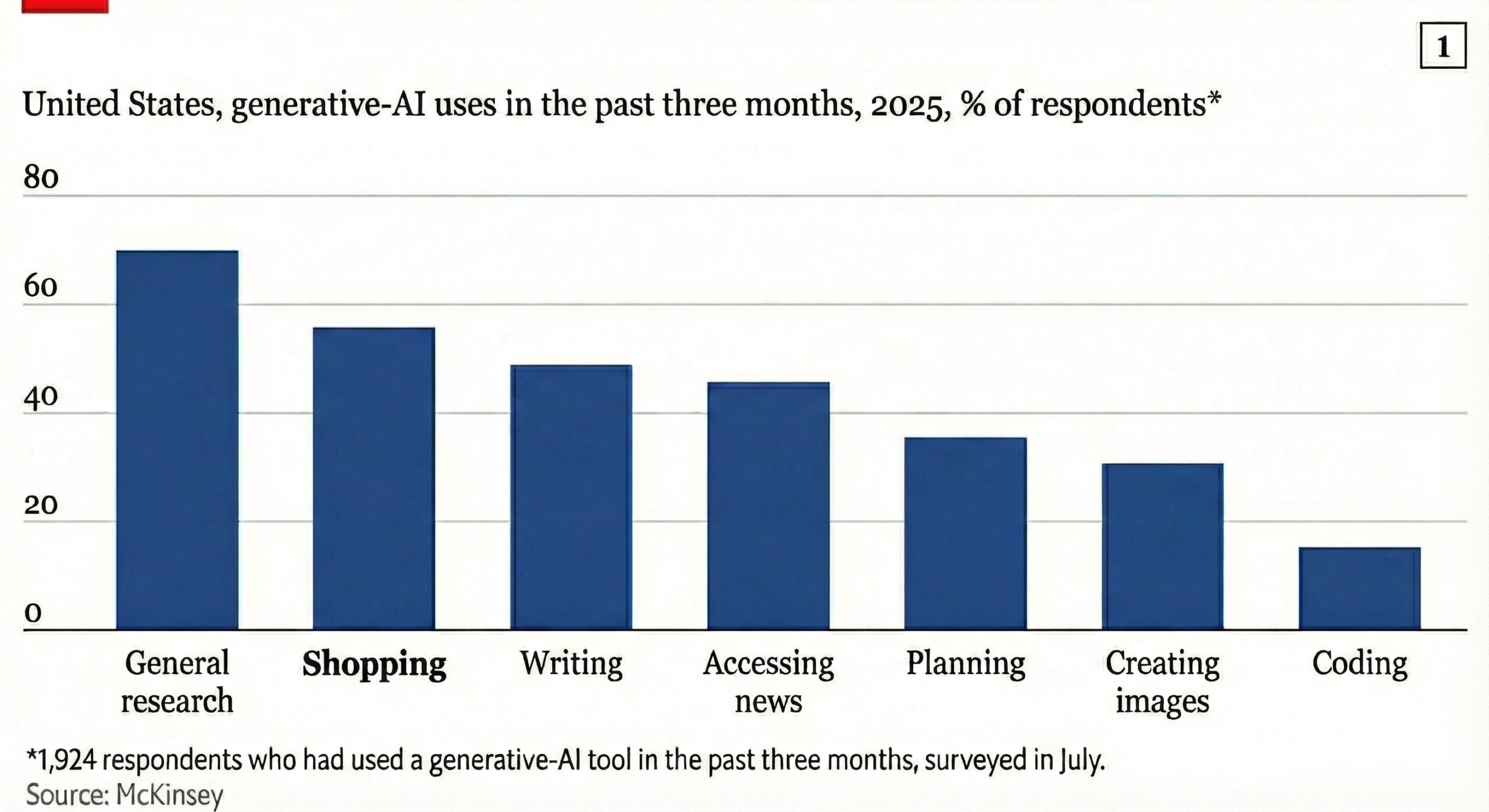
In other words, consumers are increasingly turning to chatbots to guide their shopping decisions. Instead of browsing multiple websites, shoppers now rely on AI to understand product differences, compare available options, narrow down choices, and ultimately decide what to buy. This shift shows that AI is no longer a passive research tool—it has become an active decision-maker in the purchasing process.
When a behavior reaches this level of adoption, it no longer sits at the edge of the funnel — it defines the funnel.
Consumers Are Ready to Let AI Buy for Them
This behavioral shift is backed by clear data.
A recent consumer survey cited by Morningstar and conducted by Contentsquare shows that 30% of consumers are willing to let an AI agent complete purchases on their behalf. Purchasing decisions involve money, trust, and personal preference, yet nearly one in three consumers already feel comfortable delegating that responsibility to AI. This level of trust shows that AI has moved beyond research and comparison and now plays an active role in executing commerce.
At the same time, around 2/3 of consumers in wealthy countries plan to use AI to help them shop, with even higher adoption among younger users. These numbers show that AI-assisted shopping no longer belongs to early adopters or niche audiences. It has entered the mainstream, especially among generations that will shape future spending.
Taken together, these data points show a clear progression:
- Consumers use AI to find information
- They rely on AI to evaluate options
- They increasingly trust AI to make or execute decisions
AI is no longer an edge case or a novelty feature layered onto e-commerce. It is rapidly becoming a default decision layer between shoppers and stores.
Why This Matters for E-Commerce Brands
This shift changes how people find products and how they decide to buy.
The World Economic Forum explains that AI is no longer just a helper. It now acts as an agent that can research products, compare options, make decisions, and even complete purchases with little human input. However, AI does not shop like people do. Instead of browsing pages or scrolling product lists, AI pulls information from sources it understands and trusts.
As The Economist points out, AI shopping tools work best when product information is clear and easy to compare, such as specifications, prices, and short review summaries. When brands spread information across many pages or use vague descriptions, AI struggles to use that content. As a result, a beautiful website or a high search ranking alone does not guarantee that AI will show or recommend a product.
From an AI’s point of view:
- A well-designed product page can still be hard to read
- A top-ranking page can still be hard to reference
- A well-known brand can still be skipped
AI systems only use sources they can clearly understand and reuse. If AI cannot easily summarize or compare a product, it may leave it out of the answer. That is why The Economist says search engine optimization is giving way to generative engine optimization.
As a result, the shopping journey now follows new rules. Visibility comes from being mentioned, not clicked. Trust comes from clear and consistent information, not just brand names. And many buying decisions now begin inside an AI answer, not on a store page.
For e-commerce brands, the message is simple and urgent:
if AI cannot understand your product, it cannot recommend it.
How Frevana Helps E-Commerce Adapt to AI-Led Shopping
Frevana was built specifically for this shift.
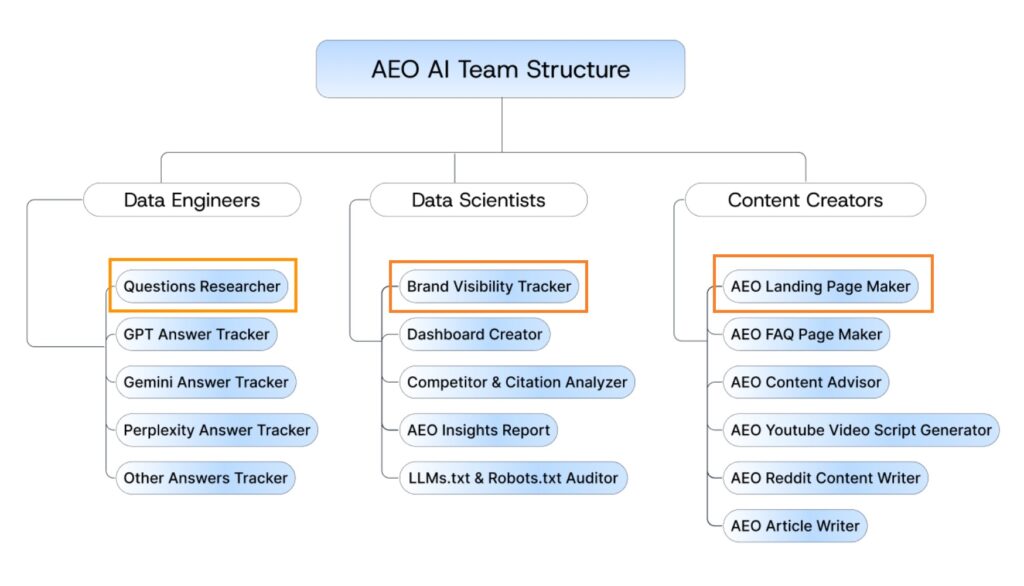
Rather than focusing only on dashboards or traffic metrics, Frevana provides an end-to-end Answer Engine Optimization (AEO) workflow designed around how AI shopping systems actually work.
1. Identify the Questions Driving AI Decisions
Frevana analyzes the real questions users ask AI when researching products — decision-oriented prompts that shape what AI recommends and what it ignores.
This moves optimization upstream, to where choices are formed.
2. Diagnose AI Visibility Gaps
Frevana evaluates how AI systems interpret your product data, reviews, and content. It shows where competitors are being cited — and why your brand may be missing from AI-generated answers.
This replaces guesswork with concrete insight.
3. Build AI-Citable Content
Frevana helps create content that AI systems can confidently reuse:
- Structured product landing page including product spec and info
- Clear FAQs aligned with AI queries
- Comparison and summary content designed for citation
The result is content that does not just rank — it participates in AI answers.
Act Now
AI is already reshaping how shopping decisions are made.
Brands that adapt early will benefit from compounding visibility as AI systems learn which sources to trust. Brands that wait risk becoming invisible in a decision process they no longer control.
The question is no longer whether AI will influence shopping. The question is whether AI will understand — and recommend — your products.
Frevana helps ensure the answer is yes.
References
The Economist — How AI Is Disrupting Shopping (Dec 2025)
World Economic Forum — This Month in AI: Shopping Agents, Energy, and Governance (Nov 2025)
Morningstar — AI Is Reshaping Online Shopping (Contentsquare survey, Dec 2025)
Wow, this is a really interesting shift! It seems like brands need to adapt quickly to this new way people are shopping.