
AI is changing how people shop online
Right now, shoppers rarely search only on Google anymore. Many now open ChatGPT, Gemini, or other AI tools when they want ideas on what to buy, especially when they have multiple options and have to decide among choices. AI is a great place if shoppers need a direct summary on product recommendations.
Global data shows that around 1.7 to 1.8 billion people have used AI tools, and 500 to 600 million use them every day 1.
Heads up for e-commerce, this shift is not just huge. It is a direct change in how people discover products. It is a change in searching mindset. A report on AI shopping behavior found that nearly 60 percent of Americans use generative AI tools for online shopping, and about one in four say ChatGPT beats Google for product research 2.
So for e-commerce brands, the question has changed.
- It is no longer only “How do I rank on Google?”
- It is now also “How do I show up in the AI answers?”
That is where Answer Engine Optimization, or AEO, comes in.
What AEO means for e-commerce
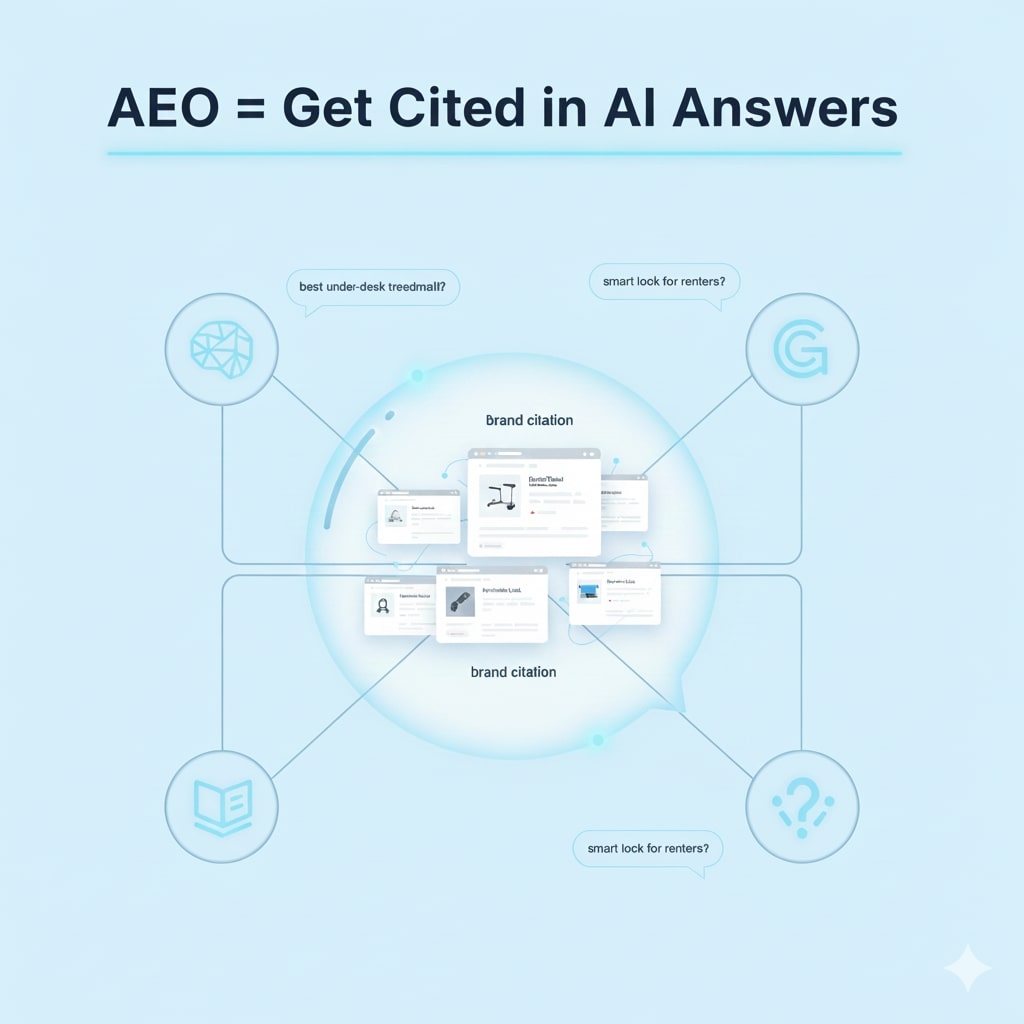
AEO, or Answer Engine Optimization, is all about helping AI tools like ChatGPT, Gemini, and Perplexity actually notice your brand. It makes it easier for these systems to find your content, understand what your products do, and use your pages as trusted sources when they answer people’s shopping questions. In simple terms, AEO helps your brand get mentioned, cited, and included in the answers that customers see.
E-commerce sites usually focus on SEO to rank product and category pages. SEO tries to get clicks from a list of links. AEO tries to get your brand named and cited inside the AI answer itself.
Industry experts define AEO as the practice of optimizing content so AI engines will cite it in their generated responses, not just list it in results 3.
For an e-commerce brand, that could mean:
- being mentioned when someone asks “best under-desk treadmill for small apartments”
- having your product page used as a source when AI tools explain “which smart lock works best for renters”
- showing up as an example when a shopper asks “affordable adjustable bench for beginners”
If AI never sees your product pages as clear, trustworthy answers, it may never bring your brand into the conversation.
Why GPT and other AI matter so much for online stores
AI is not only a search box. It also acts as a shopping assistant.
Research on AI in e-commerce shows that:
- Most online retailers now use AI in some part of their operations, such as personalization, recommendations, or chat 4.
- The AI-enabled e-commerce market already sits in the billions of dollars and continues to grow 5.
A separate report from Adobe found that traffic from generative-AI sources to U.S. retail websites jumped by over 1,200 percent in one year, and that many shoppers use AI for research, recommendations, and finding deals 6.
At the same time, generative engines such as Google’s AI Overviews and ChatGPT’s AI Mode:
- pull content from many sites at once
- rewrite that information into a summary
- choose which brands to cite
BigCommerce explains that generative engines look for pages with clear structure, helpful context, and visible sources when deciding what to reference 7.
This means your product pages and buying guides need to be easy for AI systems to understand. They should include clear structure, factual details, and answers to real shopper questions. When your content is well-organized and informative, AI tools can recognize it as a reliable source. If you do not present your information this way, the AI shopping assistant may overlook your brand and recommend competing products instead.
How AEO for e-commerce works in practice
For e-commerce, AEO focuses on a few key areas:
- Product pages
Your product detail pages should answer real customer questions. They need clear specs, use cases, comparisons, and FAQs. - Buying guides and comparison articles
These guides should mimic the way people ask questions. For example:
“Which walking pad is best for a home office?”
“What is the safest smart lock for renters?” - Technical access and structure
AI tools need to crawl your site. Files like robots.txt and llms.txt should allow AI access where appropriate. Schema markup should help machines read product details.
AEO for e-commerce does not replace SEO. It sits on top of it and points your SEO work toward the new discovery layer: AI answers.
Using Frevana’s Three Steps for E-Commerce AEO
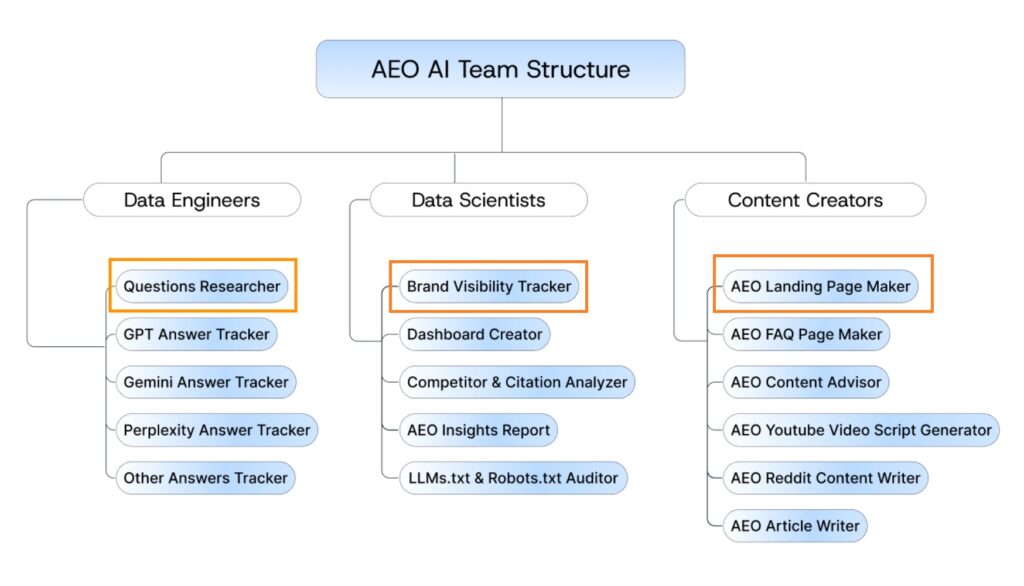
Frevana gives e-commerce brands a clear three-step way to apply AEO: Questions Researcher, Full-stack data scientist, AEO Content Creator. This process helps your products appear more often in AI-generated shopping answers.
Step 1: Questions Researcher: Discover what shoppers actually ask
Shoppers usually search in full questions, not keywords. Frevana collects these real questions from Google, Reddit, and AI tools so you can see what people truly want to know.
For e-commerce, this often reveals questions like “best walking pad for small apartments” or “smart lock that works with Airbnb.” You can then match these questions to specific products, product lines, or buying guides. This gives you a focused list of topics where you want AI to mention your brand.
Step 2: Full-stack data scientist: Analyze your AI visibility and content readiness
Frevana then checks how often your brand appears in AI answers based on the queries you got from the last step. You can see which brands AI mentions, which content AI uses as sources, and whether your pages show up at all.
The tool also reviews your llms.txt and robots.txt files, checks your structured data, and evaluates whether your product pages are readable to AI by checking if product pages include clear specs, pricing, use cases, and shipping details. You receive an AEO report that highlights where AI already trusts your content and where competitors take the lead.
Step 3: Optimize your product and content pages
With the insights from your analysis, you can update your content so AI systems can understand and cite your products more easily. Frevana helps you do this in a few simple ways.
First, you can create an AI-friendly landing page for any product, including Amazon listings. The tool pulls your product information into a clean, structured page that AI engines can read and use as a source.
You can also build user-scenario content that explains when, why, and how people use your product. This helps AI understand the real context behind your items and improves the chances of being included in recommendations.
After improving your pages with clearer details, FAQs based on real questions, and better schema markup, you can rescan them to see if your visibility improves. Many brands start seeing more mentions, more citations, and a higher share of voice after this step.
Why you should act now
E-commerce sales continue to grow, but the way people discover products is changing quickly. AI tools now shorten the research process, summarize options, and highlight only a small number of brands. If your store is not included in those summaries, you may become invisible even if your SEO is strong. AEO helps you understand what shoppers actually ask AI, see how AI currently answers, and adjust your product and content strategy so AI systems can trust and cite your pages.
With Frevana’s Question Research→ Data Scientist → Content Creation flow, you do not need a large data team or an AI specialist. You can begin with one tool that measures your presence in AI answers, and grow from there. In this new landscape, AEO ensures AI does not just talk about your product category; it talks about your brand.
References:
- Exploding Topics. “AI Usage Statistics: How Many People Use AI?” Exploding Topics, 27 Oct. 2025, https://explodingtopics.com/blog/ai-usage-statistics.
- Pr Newswire. “Nearly 60 % of Americans Use Gen-AI Tools for Online Shopping — 1 in 4 Say ChatGPT Beats Google for Product Research.” PR Newswire, 2025, https://www.prnewswire.com/news-releases/nearly-60-of-americans-use-gen-ai-tools-for-online-shopping–1-in-4-say-chatgpt-beats-google-for-product-research-302535256.html.
- Amsive. “Answer Engine Optimization (AEO): Your Complete Guide to AI Search Visibility.” Amsive, 13 June 2025, https://www.amsive.com/insights/seo/answer-engine-optimization-aeo-evolving-your-seo-strategy-in-the-age-of-ai-search.
- Capital One Shopping. “AI in E-Commerce Statistics (2025): Usage & Growth Rate.” Capital One Shopping, 2025, https://capitaloneshopping.com/research/ai-in-ecommerce-statistics.
- EComposer. “AI in E-Commerce Statistics & Trends (2025).” EComposer, 2025, https://ecomposer.io/blogs/ecommerce/ai-in-ecommerce-statistics.
- Adobe Blog. “Traffic to U.S. Retail Websites from Generative AI Sources Jumps 1,200 Percent.” Adobe Blog, 17 Mar. 2025, https://blog.adobe.com/en/publish/2025/03/17/adobe-analytics-traffic-to-us-retail-websites-from-generative-ai-sources-jumps-1200-percent?.
- BigCommerce. “How AI Posts, GEO & E-Commerce Work Together.” BigCommerce Blog, 2025, https://www.bigcommerce.com/blog/ecommerce-geo.
This is a really interesting point – it seems like AI is completely reshaping how we discover products. I’m definitely seeing more people using these tools to narrow down their choices, thanks for highlighting this!
Your article helped me a lot, is there any more related content? Thanks!