
Why content readiness matters now
Large-language-model (LLM)-based assistants like ChatGPT and Gemini are becoming key discovery channels in all industries. According to recent data, nearly 1.8 billion people worldwide have used AI tools, and about 500-600 million engage daily1.
Organizations are also adopting generative AI at a rapid pace: in the U.S. more than 54 % of adults reported using generative AI in August 20252.
Because so many people and companies rely on AI for questions, insights, decisions and research, your content must be “AI-readable” if you want to show up in their answer flows. That’s where AEO (Answer Engine Optimization) audit tools step in—they check if your content is ready for AI systems to understand, trust and cite.
What exactly is an AEO audit tool?
An AEO audit tool assesses your existing articles, landing pages, product or service descriptions and checks how well prepared they are for being incorporated into AI-driven answers. It looks at things like:
- Can the AI access your content (technical checks like robots.txt, llms.txt)
- Is your content structured clearly (headings, FAQs, schema)
- Does your article directly answer real questions users ask
- Are signals of credibility (experience, expertise, authoritativeness, trustworthiness) present
These audits result in a report showing how “ready” your content is, often with a score, and actionable fixes. Think of it as a pre-optimization check that reveals what’s blocking your visibility in AI-answer engines.
Why most content fails the readiness test
Many companies publish articles, blog posts or service pages that look fine to humans but don’t meet the rules that AI engines use to pick sources. Here are common failure points:
- Technical access issues: If your site’s llms.txt or robots.txt blocks AI-crawlers or if the page uses complex JavaScript that prevents parsing, AI may skip it entirely.
- Lack of structured data: Without schema markup or clear question/answer sections, AI tools may find your content ambiguous and therefore not suitable for citation.
- No clear question-focus: If your article is written like a marketing piece rather than an answer to a user question, AI may favor competitors that are more direct.
- Weak credibility signals: AI engines increasingly treat brand credibility as a filter. Research shows that the majority of AI citations come from brand-controlled sources. Wikipedia
In short, doing SEO alone is no longer enough. You must audit for AI‐readiness before you optimize.
How to run an AEO audit (three simple steps)
Here’s a proven workflow you can follow in any organization, with Frevana as one of the example tools powering it.
Step 1: Discover your real user questions
Use an audit tool to find which of your pages are most visible now and which real-world questions users are asking. Frevana’s question-researcher tool uncovers those user intents.
Step 2: Analyze what kind of content AI cites
Run an audit to check your technical accessibility (robots.txt, llms.txt), structured data presence, FAQ style, and trust signals. Frevana produces a detailed readiness report showing where your content meets—or fails—AI citation criteria.
Step 3: Optimize your content prepare for AI
Based on the audit report, update your pages: add schema markup, restructure with clear question headings, include FAQs, improve author credentials, ensure technical crawling is allowed. Then rescan to track improvement.
By repeating this cycle you’ll systematically move pages from “invisible to AI” toward “citable by AI.”
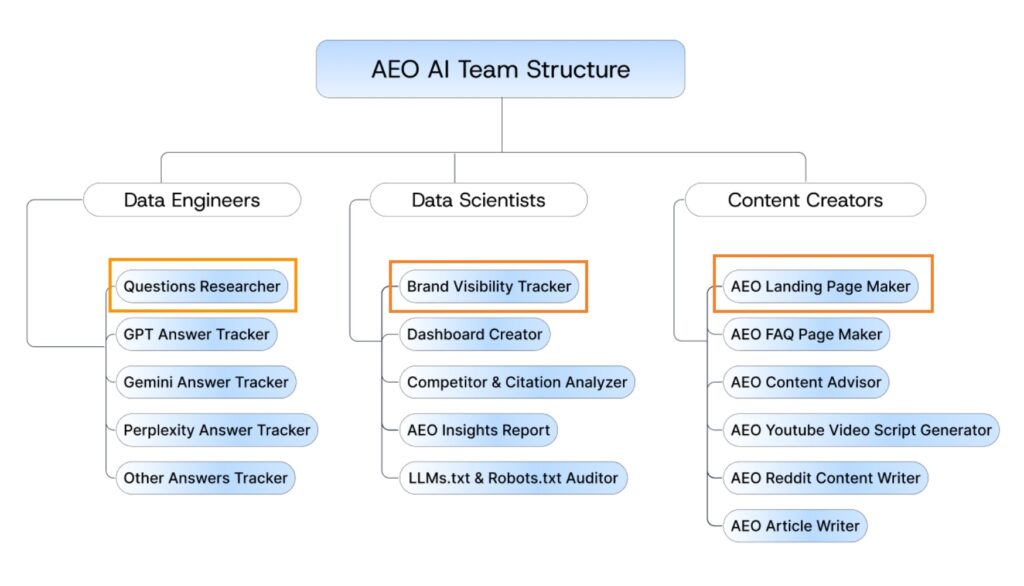
What a readiness audit tool report looks like
When you run an audit via a tool like Frevana you will typically receive:
- A readiness score (e.g., 37/100) showing overall content-readiness
- Breakdown by categories: Experience, Expertise, Authoritativeness, Trustworthiness (E-E-A-T)
- Technical checks summary: llms.txt, robots.txt, schema present or missing
- Content checks: structure, FAQs, question alignment, clarity of answer
- Actionable recommendations: what to fix, how urgent, how to prioritize
This gives you a map of what to improve, rather than guessing what might be wrong.
Why you need an audit tool now
With hundreds of millions of users and organizations adopting AI, the margin for visibility is tightening. Having hundreds of articles means little if AI never cites you as a source. Audit tools help you:
- Identify which pages are blocking AI access
- Prioritize quick wins for greatest impact
- Benchmark readiness and track improvement
In a space where AI may soon become the default answer provider, being ready gives you a competitive advantage.
7. Summary
AEO audit tools are the foundation for visibility in the era of AI-driven answers. They’re relevant for startups, SaaS companies, service businesses, publishers and enterprise brands alike—not just online shops. By discovering your content gaps, analyzing technical and structural readiness, and optimizing accordingly, you position your brand to be understood and cited by AI systems.
If you’re ready to begin, start with: Discover → Analyze → Optimize with a tool like Frevana. Your next article might not just show up in a search result. It might show up inside the answer someone asks their AI.
References:
- Exploding Topics. (2025). AI usage statistics. https://explodingtopics.com/blog/ai-usage-statistics
- Federal Reserve Bank of St. Louis. (2025). The state of generative AI adoption in 2025. https://www.stlouisfed.org/on-the-economy/2025/nov/state-generative-ai-adoption-2025
Thank you for your sharing. I am worried that I lack creative ideas. It is your article that makes me full of hope. Thank you. But, I have a question, can you help me?