
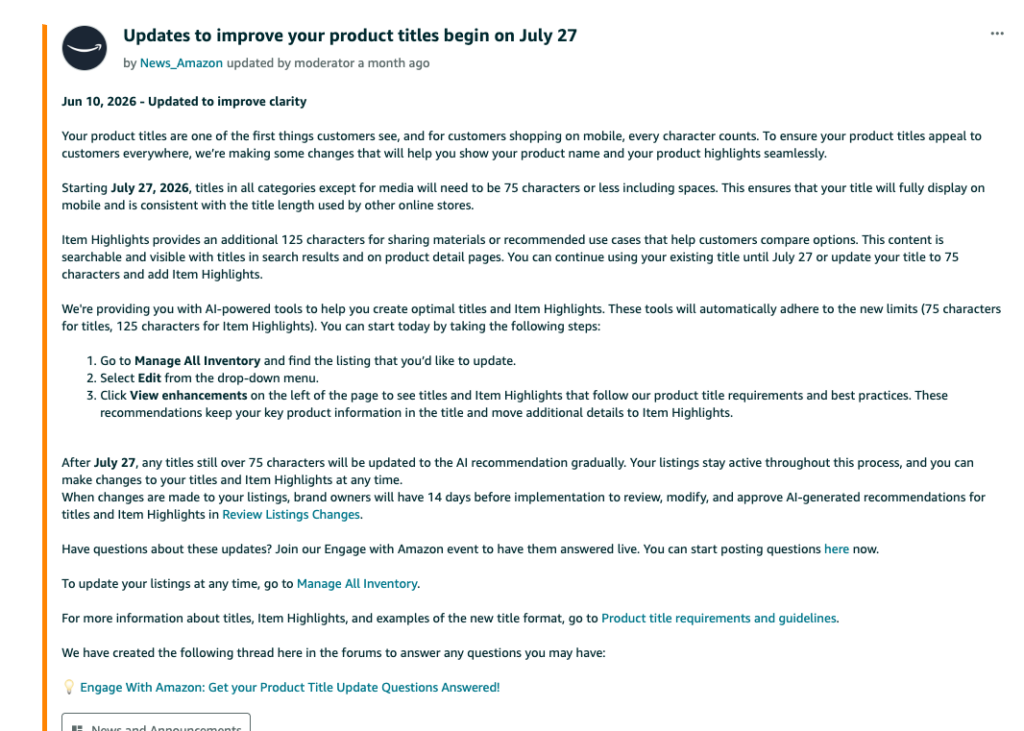
Starting July 27, 2026, Amazon will limit most product titles to 75 characters including spaces. Media categories are excluded.
Amazon is also adding a new Item Highlights field with up to 125 characters. This field can appear near the title in search results and on product detail pages, and it is searchable.
This is not just a title update. It is a full Amazon listing optimization shift.
If sellers simply cut words from old titles, they may lose important keywords, search visibility, and sales. The better approach is to rebuild the listing structure for both Amazon SEO and Amazon AEO.
Key Changes
| Update | What It Means |
|---|---|
| Effective date | July 27, 2026 |
| Title limit | 75 characters including spaces |
| Applies to | Most categories except media |
| New field | Item Highlights |
| Item Highlights limit | 125 characters |
| Search visibility | Item Highlights are searchable |
| AI risk | Over-limit titles may be rewritten by Amazon AI |
Why This Matters
For years, many sellers used Amazon titles as keyword containers. Long titles often included the brand, product type, size, color, material, features, use cases, and keyword variations.
That strategy no longer works.
On mobile, long titles are often cut off. Under the new rule, every character must serve a clear purpose.
The new title should answer one question:
What is this product?
The rest of the listing should explain why the product is relevant, useful, and worth buying.
Do Not Simply Delete Keywords
The biggest mistake is cutting words until the title fits.
Important keywords should not disappear. They should move to the right listing fields.
| Listing Field | New Role |
| Title | Brand, core product keyword, strongest differentiator |
| Item Highlights | Materials, use cases, features, specifications |
| Bullet Points | Benefits, pain points, shopper intent |
| Description / A+ | Deeper context, scenarios, trust-building details |
| Backend Search Terms | Relevant terms not naturally used elsewhere |
| Attributes | Structured data for Amazon AI classification |
Best Title Formula
Use this structure:
Brand + Core Product Keyword + Primary Differentiator or Specification
Example:
| Version | Example |
| Old title | ABCBrand Luxury Silk Pillowcase for Hair and Skin 100% Mulberry Silk Pillow Cases 21 Momme Cooling Pillow Cover with Hidden Zipper Standard Size 20×26 inches Grey |
| New title | ABCBrand 100% Mulberry Silk Pillowcase, 21 Momme Cooling Standard Grey |
| Item Highlights | For hair and skin care, hidden zipper, fits 20×26 inch pillows, 1-pack |
The information is not removed. It is redistributed.
How to Choose Keywords
Do not guess which keywords belong in the title.
Use data from:
- Amazon Brand Analytics
- Search Query Performance Report
- Advertising search term reports
- CTR and conversion rate
- Purchase share
- Competitor research
- Organic ranking data
The keyword that drives the most purchases should usually stay in the title. Secondary keywords can move into Item Highlights, bullets, descriptions, backend search terms, and attributes.
Why AEO Matters
Amazon SEO helps your product rank in search.
Amazon AEO, or Answer Engine Optimization, helps Amazon’s AI systems, recommendation engines, and shopping assistants like Rufus understand and recommend your product.
AEO-friendly listings are:
- Clear
- Structured
- Specific
- Benefit-led
- Consistent across fields
- Supported by complete attributes
This update favors sellers who write listings for shoppers, search engines, and AI systems at the same time.
Simple SOP Before July 27
| Step | Action |
| 1 | Export active listings and find titles over 75 characters |
| 2 | Audit titles, bullets, descriptions, backend terms, and attributes |
| 3 | Identify high-converting keywords from search and ad data |
| 4 | Rewrite titles using Brand + Core Keyword + Differentiator |
| 5 | Add Item Highlights under 125 characters |
| 6 | Move secondary keywords into bullets, descriptions, backend terms, and attributes |
| 7 | Compare Amazon AI suggestions, but do not blindly accept them |
| 8 | Monitor impressions, CTR, conversion rate, ads, and keyword rank after updates |
Rebuild Your Listing for Amazon’s New Title Requirements
Frevana’s Amazon Listing Rebuilder now supports the new Item Highlights field.
You can use it to rebuild your product title, Item Highlights, bullet points, product description, and backend search terms so your listings meet Amazon’s new 75-character title requirement while keeping your SEO strong.
For sellers with large catalogs, this is especially important. Frevana helps you avoid simple keyword deletion by using keyword research, listing structure, Amazon SEO logic, and AEO checks to decide which terms stay in the title and which terms move elsewhere.
The goal is simple: stay compliant without losing the keywords that drive traffic, clicks, and sales.
Bottom Line
Amazon’s 75-character title rule is not about making titles shorter.
It is about making listings smarter.
Sellers who only delete words may lose visibility. Sellers who rebuild listings with SEO and AEO in mind can stay compliant while protecting traffic and conversion.
Do not wait for Amazon AI to decide which keywords matter most. Update your listings before July 27, 2026.
FAQ
What is Amazon’s 75-character title limit?
It is Amazon’s new rule requiring most product titles to stay within 75 characters including spaces, starting July 27, 2026.
What are Item Highlights?
Item Highlights are a new 125-character field for short product details such as materials, use cases, features, specifications, and selling points.
Are Item Highlights searchable?
Yes. Item Highlights are searchable and may appear near the product title in search results and on product detail pages.
Will Amazon AI rewrite long titles?
Amazon says titles over 75 characters after July 27 may be gradually updated to AI recommendations.
Can shortening my title hurt Amazon SEO?
Yes. If important keywords are deleted instead of moved into other listing fields, search visibility and sales may decline.
What is the best title structure?
Use: Brand + Core Product Keyword + Primary Differentiator or Specification.
What is Amazon AEO?
Amazon AEO means structuring listing content so Amazon’s AI systems and shopping assistants can understand and recommend your product.
What is the biggest mistake sellers should avoid?
The biggest mistake is simply deleting keywords. Sellers should rebuild the full listing structure instead.