
The Hidden Problem Behind AI Search
Have you ever noticed that when you ask ChatGPT or Google Gemini for product advice, you often see the same few brands even for different prompts? That’s because AI tools don’t just browse the web like Google does. They pull information from pages that are structured, readable, and easy to understand.
A recent U.S. study found that 60% of Americans already use generative AI tools for brands advice such as comparing products or reading recommendations (PR Newswire, 2025). Another Adobe survey confirmed that 38% of consumers have used AI tools to shop online, and over half plan to do so this year (Adobe, 2025).
Therefore, the new competition isn’t just on Google’s front page. It’s inside AI answers. And if your content isn’t built for AI to read or cite, your brand may not appear at all. That’s where AEO readiness scanning comes in.
What “AEO Readiness” Actually Means
AEO stands for Answer Engine Optimization, which focuses on helping AI systems like ChatGPT, Gemini, and Perplexity understand, and more importantly, trust your content in their generated answers.
Traditional SEO is about showing in the top results in Google search. AEO is about being cited in AI answers. When a user asks, “What’s the best platform to record my sleeping habits?”, the AI doesn’t just look for top-ranking articles. It picks pages that are structured clearly and trustworthy enough to quote.
Research shows that pages with clear headings, schema markup, and question-based content are far more likely to appear in AI-generated summaries (Whitepeak.io, 2025). In other words, AI readiness means your content speaks the same language as the systems generating answers.
Why You Should Scan Before You Optimize
You can’t fix what you can’t measure. Many teams rewrite or optimize pages based on SEO habits. But without scanning for AEO readiness, they’re just assuming what they should be doing.
AI systems like ChatGPT and Gemini don’t rely on keyword density or backlinks. They prefer content that is clear and structured, and of course, accessible on the technical side. According to eMarketer, pages with structured data account for over 86% of AI citations, compared to less than 10% for unstructured content (eMarketer, 2025).
This means if your page doesn’t have schema, FAQs, or clear metadata, AI tools might not even “see” it. That’s why running a readiness scan first is essential. It shows what’s blocking your content from being cited.
Think of it as a health check for visibility: before spending time rewriting, you should know if AI can even read your page in the first place.
How to Scan Your Articles Using Frevana
Step 1: Paste Your Article Link
Go to Frevana’s Content Evaluation tool and paste your article or product page URL. The scanner loads your content and prepares it for analysis.
Step 2: Let Frevana Analyze the Page
Frevana checks whether your page is AI-accessible by analyzing:
- Missing or broken metadata and schema markup.
- Missing llms.txt file (which helps AI access your site).
- Unclear titles or FAQ sections.
- Gaps in product information or comparison content.
Step 3: Get Your AEO Readiness Score
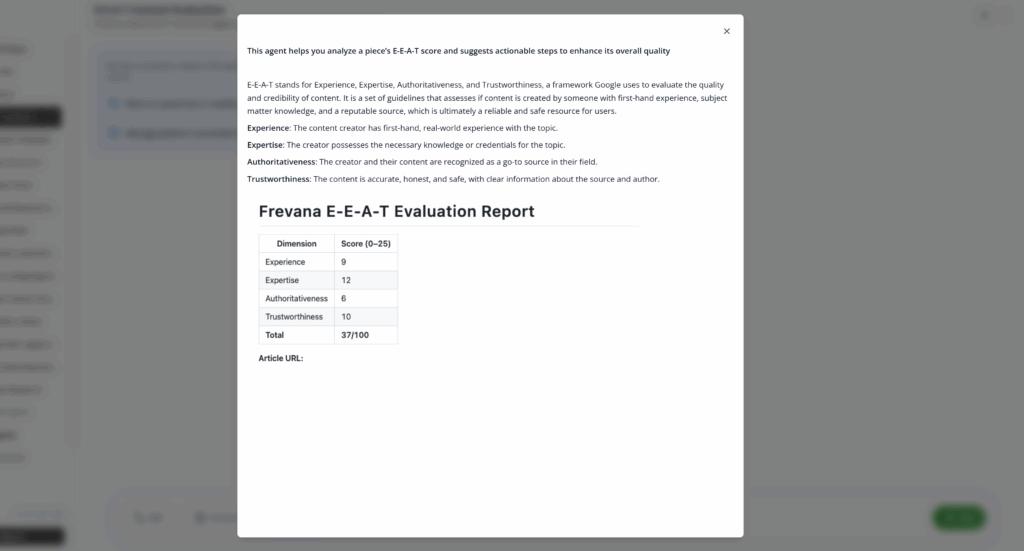
Once scanned, Frevana shows an easy-to-read “AI Readiness Score.”
It tells you how likely your page is to appear in AI-generated answers.
Step 4: Apply Smart Fix Suggestions
For every issue, Frevana provides tailored solutions, such as:
- Add FAQ questions that match real customer searches from Reddit and Google.
- Insert schema to describe your product data to AI systems.
- Improve clarity in headings and comparison tables.
Step 5: Rescan to See the Difference
After making the recommended changes, rescan your page.
Frevana instantly updates your readiness score so you can track improvements.
What a “Ready for AI” Page Looks Like
AI tools prefer content that looks organized and objective, not salesy.
A strong, AI-readable page often includes:
- A clear title that answers a real question.
- Short sections that explain the answer in plain English.
- Structured data, schema, and updated metadata.
- An FAQ block that mirrors user intent.
For example, a blog titled “Best Adjustable Benches for Small Apartments” that lists product specs, user needs, and FAQs is more likely to be cited by AI than one that only describes features.
A 2025 analysis by Writesonic found that adding structured data increases a page’s chance of being selected for AI-generated answers by over 30% (Writesonic, 2025).
Frevana helps you identify and apply those exact improvements automatically.
Real Story: From Hidden to Visible
A mid-sized fitness brand scanned its articles using Frevana and discovered missing schema tags, outdated FAQs, and inconsistent formatting.
After fixing those issues, their product pages began appearing in ChatGPT answers and Perplexity search results for “best walking pads for home offices.”
Within a week, their AI visibility score increased by 54% — proof that structured, AI-readable content makes all the difference.
Conclusion: Scan, Fix, and Be Seen
AI has become the new search gateway. If your brand doesn’t show up in AI answers, you’re invisible to a growing share of online shoppers.
AEO readiness scanning helps you catch the invisible issues that prevent your site from being cited. Frevana’s tool gives you a clear readiness score, smart fix recommendations, and the confidence that AI systems can understand your content.
Try today, in just a few minutes, you’ll learn exactly what’s stopping your pages from showing up in AI search results — and how to fix it.