
Introduction
Nowadays, people no longer use simple keywords to type in the search bar to find brand results; instead, they ask complete, specific questions like “Will a magnetic rowing machine hurt my lower back if I had surgery?” on AI platforms to get recommendations. Therefore, with the rise of answer engines like ChatGPT, Perplexity, and Gemini, brands should start to shift their mindset from being seen in the top ten links on search engines to getting visible in AI answers. These platforms respond directly to users’ complete questions in a dialog-like way, without sending them to external links. As a result, if your brand isn’t part of those responses, you may as well be far away from your users.
This change in searching has created a new word: Answer Engine Optimization (AEO). It is important for brands because it’s no longer just about what people type in Google; it’s about understanding what real customers actually ask and making sure your brand appears when AI answers. At Frevana, we are aware of this shift and want to provide brands with a new logic for how to relate their content to the questions customers really ask—not just in search, but in answers.
What keywords mean in AEO?
AEO is about making sure that AI platforms can enter, comprehend, and cite your content directly when users ask questions. So unlike search engines, which list your brand’s websites, AI cites your content and transforms it into dialog-like answers.
Therefore, AEO keywords are fundamentally different from those classic SEO keywords we traditionally know. They are not just isolated keywords or multi-word phrases like “rowing machine discount” or “best pizza NYC.” Keywords that are important for AEO include the complete sentences of natural language people actually ask, for example:
- Full questions: “Is [product] safe for kids?” or “How do I fix [issue] with my [device]?”
- Concerns: “Will this supplement interact with my medication?” or “Why is my app crashing after the update?”
- Brand comparisons: “What is the major difference between [brand] and [competitor]?” or “Is it worth buying [brand] or [competitor]?”
- Use-case or scenario-based questions: “Will this work for my [unique situation]?” or “Can I use this camera for nighttime wildlife photography?”
Keywords used for AI search express users’ intent, concerns, and contexts. They map to the critical purchasing or deciding moments right before users make a decision, reflecting what they really feel at that time, not just what they type.

Why AEO Keywords Matter (and How They Differ from SEO Keywords)
This shift from SEO to AEO isn’t just a trend; it is a fundamental change in how people find and trust information online. Here’s why:
People now ask AI in full sentences
61% of US adults have used AI in the past six months, and nearly 1 in 5 use it daily1. Moreover, 42% of users use it for Answering questions/explaining topics like natural language queries (“Is a rowing machine worth it if I have knee pain?”)2. At the same time, ChatGPT has reported nearly 700-800M weekly users in 2025, meaning more and more people now “ask” AI directly345.
SEO values clicks; AEO values visibility in answers.
As we know, traditional SEO values short phrases to win clicks. However, users often get what they need without clicking at all, such as from overviews, Reddit comments, or website taglines: in 2024, nearly 60%67 of Google users ended up with no clicks. With the growth of AI overviews, zero-click searches reduce organic web traffic by 15-25%89.
On the other side, AEO keywords, which are full questions that users really ask, aim to get your content cited in AI answers, even when no click happens. It is advantageous, especially for small brands who have a limited budget for Google paid ads: they can also win AI visibility without ranking high on traditional SERPs, as long as they publish clear and trustworthy answers to real questions.
These questions drive purchase decisions
Keywords for AEO show the real questions people often ask before making decisions: their worries, reasons, and what finally persuades them, such as safety, monetary value, or fit. There are more and more consumers who are now comfortable trusting AI for advice: 44% of them say they rely on AI recommendations, and 65% already trust Google’s AI Overviews for answers, according to Omnicom’s 2025 report10. When brands answer those kinds of questions directly on their websites, through FAQs, blogs, or other social media platforms, AI is more likely to trust and cite the content, resulting in more users’ selections. This approach is especially valuable for startups or niche brands that do not yet have strong SEO authority.
What Frevana Delivers
Frevana’s Question Research function is built to adapt this shift. It searches exact questions and queries your brand should answer from real users, and the real-life user scenarios that make those answer appealing and credible.
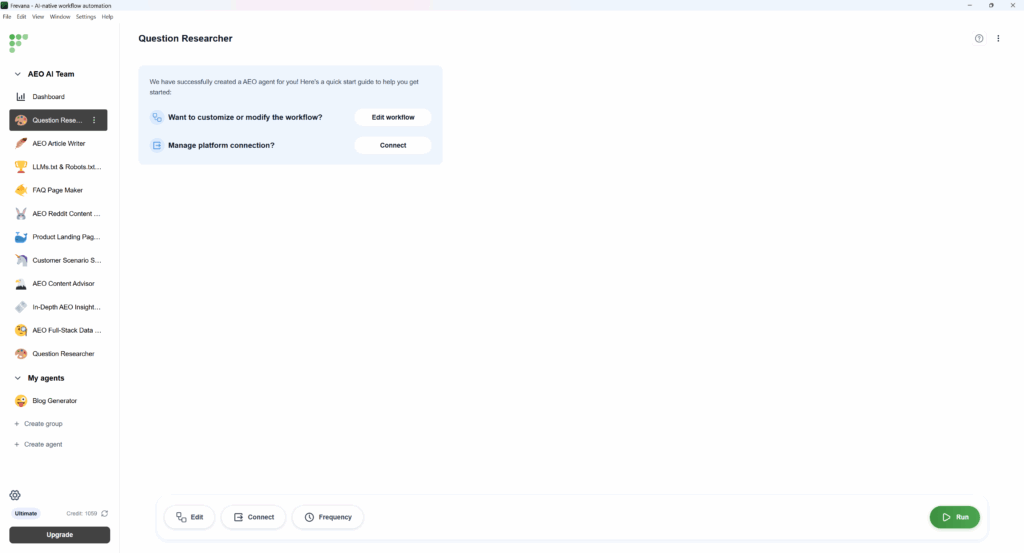
Access to 20M+ Real Customer Questions
Frevana has a question library of over 20 million buyer questions from across industries. Different from those generic questions, the queries Frevana provide are the actual words people use when searching AI for making comparison, speaking concers, or trying to imagine how a product works in real life.
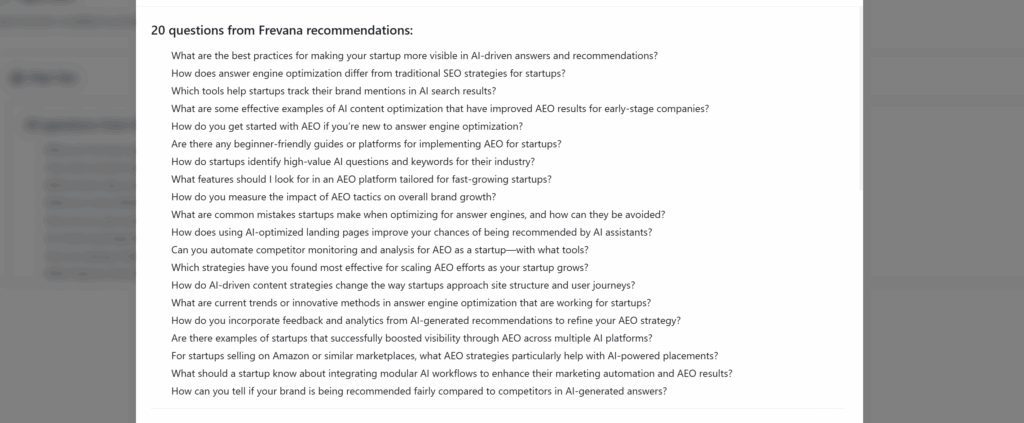
Why it matters for AEO
This massive question database mean you are not assuming what your users are asking, but instead you are aligning your product/content to what natural answers Answer Engines cite most often.
Questions Expansion from Google and Reddit
Frevana does not just rely on the static database, but also collects real-time search queries from Google (and also “you may also ask”) and Reddit (on which users often exchange honest comments and experiences). Then, Frevana transfer those signals into a list of complete natural questions optimized for answer engine visibility.
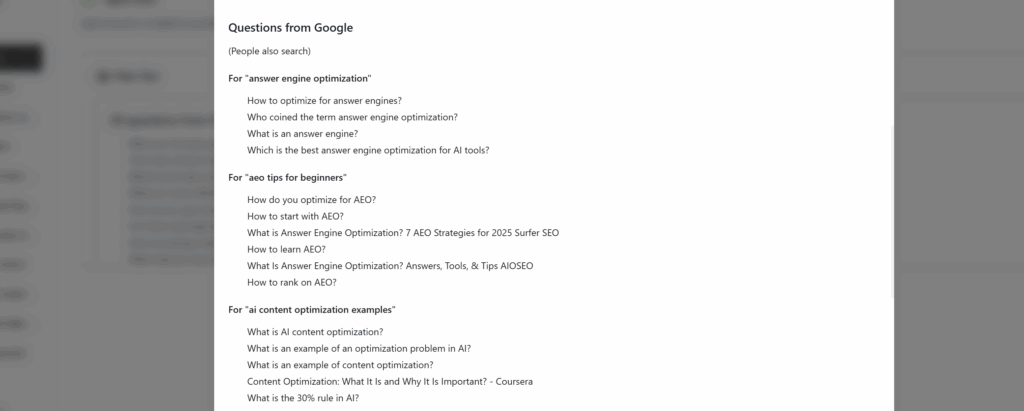
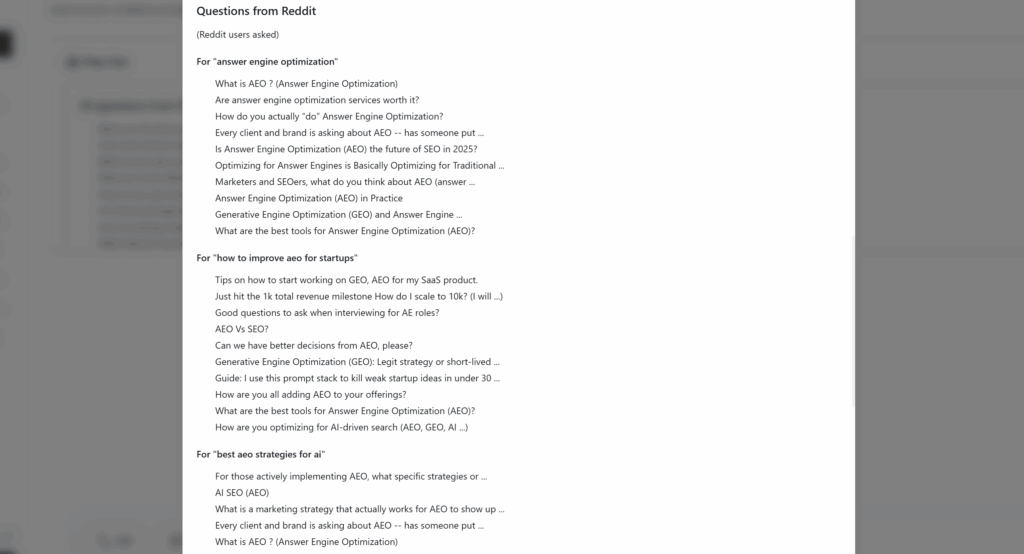
Why it matters for AEO
It matters for AEO because the combination of authoritative sources (like Google) with authentic user dialogue (from Reddit) could resonate with both AI algorithms and real users. By modifying your content directly answering those questions,
If your content directly answers those questions, it can ensure you are speaking to real customer concerns, not just isolated keywords.
User-Using Scenario Collect (E-commerce)
Frevana also has a tool for e-commerce. It collects the user-scenarios online and generates real-life product using scenarios, which answers not only who is using the product, in what setting, and why they probably need it. For example, you will get scenarios like “Power bank use for charging large devices when camping” or “New parent needing one-hand stroller fold on a subway platform”.
Why it matters for AEO
Like we explained above, Answer Engines value content that is clear, well-oriented, and related to real-life situations. If your content is scenario-based, it will make your product pages more trustworthy and boost your visibility in AI. Plus, it helps users imagine under what circumstances they can use the products, even ones they might not have thought of, helping to boost conversions.
How Can Brands Use This
Once you have your real customer questions, it’s time to put them to work across your website. Start by turning these questions into clear FAQ blocks. You can place these on your homepage or dedicate a full FAQ page. Next, weave specific questions into landing page sections. For example, if customers often ask, “Is this safe for seniors?” make that a prominent heading and answer it directly.
Take questions about how you compare to others and build competitor comparison pages. These pages help shoppers decide and also give AI engines a clear source for direct answers. For more how-to or troubleshooting questions, create detailed support articles. Each answer should be concise and easy to understand.
What you should do now
Here’s the ahead alert: SEO keyword tools only show you what people are searching, but not what they “ask”. But as AI reshapes how customers find answers, just ranking top in SERPs is not enough. You need to be in the answer. AEO keyword research show you the “real” questions your audiences may ask on AI platforms. It ultimately drives trust and wins recommendations and citation in AI answers.
Frevana can give you the list of questions that actually turn users’ concerns into trustworthy content. No endless blue links surfing. Just the questions that will make your brand show up as “the” source when it matter most.
So don’t wait, AI and answer engines are rewriting the rules “right now”. Hand us your product and we will show you the precise questions you need to answer to start being visible in AI-driven customer conversations.
References:
- Menlo Ventures • 2025: The State of Consumer AI • June 26, 2025. Menlo Ventures
- Verasight • The Age of AI (July 2025) • July 17, 2025. Verasight
- TechCrunch • Sam Altman says ChatGPT has hit 800M weekly active users • Oct 6, 2025. TechCrunch
- Reuters • OpenAI’s weekly active users surpass 400 million • Feb 20, 2025. Reuters
- Business Insider • Sam Altman touts ChatGPT’s 800 million weekly users • Oct 2025. Business Insider
- SparkToro • 2024 Zero-Click Search Study (US & EU) • July 1, 2024. SparkToro
- Search Engine Land • Zero-click searches rise, organic clicks dip: Report • June 5, 2025. Search Engine Land
- Bain & Company (Insight) • Goodbye Clicks, Hello AI: Zero-Click Search Redefines Marketing • Feb 2025. Bain
- Bain & Company (Press release) • Consumer reliance on AI search results signals new era of marketing • Feb 19, 2025. Bain
- Omnicom Media Group • New report provides a roadmap for marketers in the world of GenAI search • Oct 7, 2025. OMG Transformation –