
Introduction
For decades, online discovery has orbited around search engine optimization (SEO): the game of winning Google’s “ten blue links” through relevance, authority, and technical prowess. But as artificial intelligence accelerates and “answer engines” like ChatGPT, Perplexity, and Google SGE become the default portals of online knowledge, a new optimization frontier has emerged—Answer Engine Optimization (AEO).
If SEO was a battle for clicks, AEO is a competition to be cited and trusted by AI engines. The rules, audience, and tactics have all changed.
1. SEO’s Traditional Audiences—Humans and Crawlers
SEO thrived by balancing the needs of two core audiences:
Humans:
- Clear writing, engaging stories, and content that solved real user intents.
- Optimized headlines, mobile-friendliness, page speed, and engaging experiences.
Crawlers (Googlebot, Bingbot):
- Keywords in titles and headers.
- Well-crafted meta-descriptions and schema markup.
- Robust internal linking and clean site structure for optimal crawling.
The result:
SEO always meant optimizing for both people and algorithms, chasing higher rankings and more organic clicks.
2. AEO’s New Audience—AI Engines
The rise of answer engines represents a tectonic shift.
Now, AI engines—like ChatGPT, Perplexity, and Google SGE—don’t just display a list of links. They synthesize, summarize, and directly answer user queries, often citing only a few authoritative sources.
What do these engines need?
- Structured, machine-friendly content: rich schema, tables, and clear FAQs.
- Entity clarity: Who/what is being talked about, and why is it credible?
- Fact-based, concise answers: Truth and clarity trump excessive marketing.
- Citations: Inclusion means trust—being cited in the answer = visibility.
Success is now measured not in clicks, but in how often and how positively your brand is referenced in AI-generated responses.
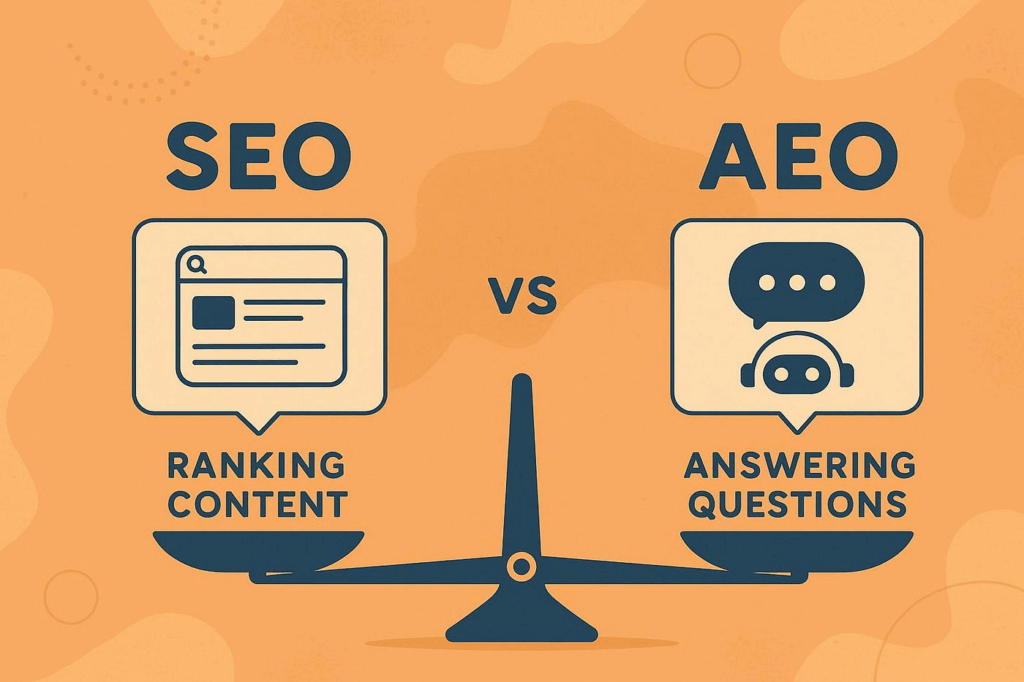
3. SEO vs AEO: Direct Comparison
Let’s distill the shift into its core elements:
| Category | SEO | AEO |
|---|---|---|
| Audience | Humans and search crawlers | AI answer engines (LLMs, chatbots, SGE, etc.) |
| Goal | Rank high, earn clicks, drive traffic | Be cited as a trusted source in AI answers |
| Content Strategy | Keyword-driven, long-form, page-focused | Entity-driven, fact-based, cluster/thematic organization |
| Optimization Unit | Individual webpages | Topics/entities, knowledge clusters |
| Metrics | Rankings, traffic, CTR, conversions | Mentions, citation quality, zero-click visibility, sentiment |
| Tactics | Meta tags, backlinks, on-page SEO | Schema, FAQs, data feeds, authoritative citations |
| User Journey | User clicks to your site | User may never click; brand cited within the answer |
| Success Value | Being seen and clicked | Being referenced, trusted, and summarized |
Key distinction:
SEO = balancing human reading and algorithmic crawling.
AEO = feeding facts to AI for authoritative, machine-to-human answers.
4. Why the Shift Matters for Brands
- Search is “Zero-Click”: Over half of Google searches today result in no website visit—answers are consumed on the spot.
- Traffic ≠ Influence: In AEO, the source is critical: If your brand isn’t cited in an answer, you may disappear from the consumer’s consideration altogether.
- Trust is Automated: If AI answers repeatedly reference your brand, you gain a new digital authority—akin to being reviewed by top editorial sites, but at generative scale.
“When your SKU or brand isn’t named in the LLM’s main answer, it’s not just demoted—it’s potentially erased from the buying journey entirely.” [Forbes, Reference 2]
Business Impact:
- Discovery, reputation, and influence now happen inside the AI engine, even when there’s no site click.
- Reputational risk: If not cited (or misrepresented), you lose mindshare by default.
- The “winner takes all” logic intensifies—fewer brands get outsized visibility.
5. Preparing for the Future: Your AEO + SEO Playbook
- Foundational SEO Still Matters!
Technical excellence (site speed, crawlability, quality content) remains a baseline. - Upgrade for AEO:
- Invest in schema.org markup for products, FAQs, reviews, and organizational entities.
- Structure information for maximum machine-readability (tables, lists, concise summaries).
- Fact-check and clearly reference claims; include up-to-date data.
- Expand focus to off-site authority: Earn mentions in trusted sources and third-party sites, not just on your own.
- Track New KPIs:
- Use emerging tools to monitor AI answer citations, mention frequency, and sentiment.
- Measure “Share of Answers,” not just “Share of Clicks.”
- Design for All Three Audiences:
- Humans: Engaging, helpful content.
- Crawlers: Technical health.
- AI Engines: Structured, concise, factual, and easily referenced data.
6. How to Adapt: Frevana’s Approach to AEO
Emerging tools like Frevana are bridging this gap:
- Track where and how your brand is cited inside AI engines.
- Diagnose “AI rank” and presence in generative answers.
- Provide structured content templates to boost your likelihood of being referenced.
This dual approach ensures your SEO foundation stays strong—while your content becomes machine-optimized for AEO’s requirements.
Conclusion
AEO isn’t a rejection of SEO; it’s the next logical step. Technical hygiene, authority, and high-caliber content aren’t going away—they’re prerequisites. What’s evolving is who your content is optimized for, and what “visibility” means in the AI era.
Brands embracing AEO now—using platforms like Frevana, building structured knowledge, and adapting to AI answer engines—will lead in tomorrow’s digital landscape, where trust and influence flow through AI-powered answers, not just web traffic.
Thanks for such a clear and timely breakdown of the shift from traditional SEO to the world of AEO! I found the idea that “being cited” by AI engines now counts more than ranking high on a link list especially eye-opening — it really reframes how we think about visibility in 2025.