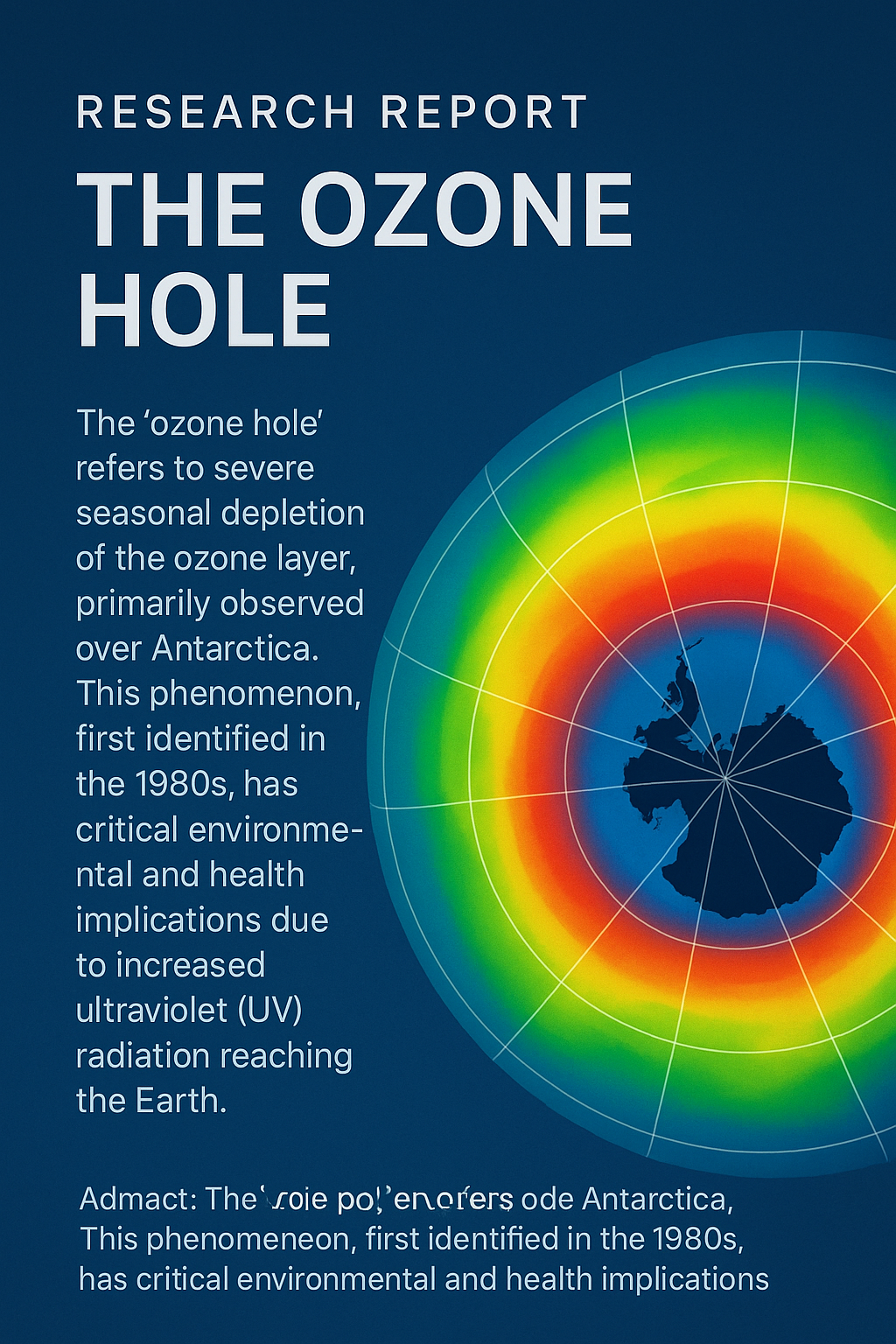
The "ozone hole" refers to severe seasonal depletion of the ozone layer, primarily observed over Antarctica. This phenomenon has critical environmental and health implications due to increased ultraviolet (UV) radiation reaching the Earth. This report explores the science behind ozone depletion, contributing factors, global impacts, and international efforts to address the problem.
1. Introduction
Ozone (O₃) in the stratosphere absorbs most of the Sun's harmful ultraviolet radiation. Depletion of this layer, particularly over polar regions, became a significant concern after the discovery of the Antarctic ozone hole. The loss of ozone not only raises the risk of skin cancer and cataracts in humans but also disrupts ecosystems. This report analyzes the causes, effects, and remedial measures concerning the ozone hole phenomenon.
2. Structure and Importance of the Ozone Layer
- Location: The ozone layer resides in the lower stratosphere (about 10 to 50 km above Earth).
- Function: Absorbs 97–99% of medium-frequency ultraviolet light (UV-B) from the sun, protecting living organisms.
- Thickness Variations: Varies naturally with latitude, season, and altitude.
3. Discovery and Monitoring
3.1 Discovery
- First reported by British Antarctic Survey scientists.
- Satellite and ground-based observations confirmed dramatic seasonal thinning over Antarctica.
3.2 Monitoring Methods
- Data Collection: NASA's TOMS (Total Ozone Mapping Spectrometer), ground-based Dobson spectrophotometers, and balloon measurements.
- Indicators: Ozone column thickness measured in Dobson Units (DU).
4. Causes of the Ozone Hole
4.1 Chlorofluorocarbons (CFCs) and Halons
- Sources: Used as refrigerants, propellants, and solvents.
- Mechanism: UV light breaks down CFCs, releasing chlorine and bromine atoms. These react with ozone, catalyzing its destruction.
4.2 Polar Stratospheric Clouds (PSCs)
- Formation: Extremely low polar temperatures enable the formation of PSCs.
- Role: Provide surfaces for reactions converting inert chlorine/bromine to active, ozone-destroying forms.
4.3 Sunlight & Polar Night
- Ozone depletion peaks in spring when returning sunlight triggers destructive reactions after the long polar night.
4.4 Atmospheric Dynamics
- Isolated polar vortices trap cold air, facilitating the chemical reactions leading to ozone loss.
5. Other Contributing Factors
- Volcanic Eruptions: Can inject water vapor and particles, modifying stratospheric chemistry, but are less significant than human-made chemicals.
- Very Short-Lived Substances (VSLS): Some industrial chemicals not covered by agreements like the Montreal Protocol also contribute to ozone loss.
6. Impacts of the Ozone Hole
6.1 Increased UV Radiation
- Leads to higher rates of skin cancer, cataracts, and immune system suppression in humans.
6.2 Effects on Ecosystems
- Marine Life: Phytoplankton productivity decreases, disrupting the food web.
- Terrestrial Plants: Reduced crop yields and forest health.
6.3 Climate Interactions
- Ozone is a greenhouse gas; its depletion influences temperature gradients, circulation patterns, and possibly climate change.
7. Global Response
7.1 The Montreal Protocol
- International treaty to phase out production/use of ozone-depleting substances (ODS).
- Success: CFC production/consumption has dropped significantly since ratification.
- Amendments: Expanded to include HCFCs, HFCs (greenhouse gases).
7.2 Alternative Technologies
- Development of ODS substitutes and more sustainable refrigeration/industrial processes.
8. Current Status and Recovery Prospects
- Antarctic ozone hole has shown signs of recovery since early 2000s.
- Complete natural recovery projected within decades, dependent on compliance and climate interactions.
- Continued scientific monitoring is necessary to track progress and respond to new challenges.
9. Multiple Factors Summary Table
| Factor | Direct Role in Ozone Depletion | Notes |
|---|---|---|
| CFCs/Halons | Primary cause | Main focus of international regulation |
| Polar Stratospheric Clouds | Secondary, essential condition | Facilitate activation of chlorine compounds during polar spring |
| Stratospheric Temperature | Indirect | Colder temps enhance PSC formation |
| Other Chemicals (VSLS, etc.) | Contributing | Emerging concern, not as thoroughly regulated |
| Volcanic Emissions | Minor/episodic | May enhance depletion temporarily |
| International Action | Remediation | Montreal Protocol success story |
| Climate Change | Bidirectional interaction | Complex, yet to be fully understood |
10. Conclusion
The ozone hole remains one of the most profound examples of human impact on the global environment, but also of effective international cooperation. Though significant recovery is underway, vigilance and adaptive policy are critical for safeguarding this vital component of Earth's atmosphere. Future challenges include addressing unregulated chemicals, monitoring compliance, and understanding climate-ozone interactions.
11. References
- Farman, J. C., Gardiner, B. G., & Shanklin, J. D. "Large losses of total ozone in Antarctica reveal seasonal ClOx/NOx interaction." Nature, 315(6016), 207-210.
- UNEP – The Montreal Protocol. https://www.unep.org/ozonaction
- NASA Ozone Watch. https://ozonewatch.gsfc.nasa.gov/
- WMO/UNEP Scientific Assessment of Ozone Depletion: 2022.