
The increasing demand for intelligent, autonomous, and context-aware software systems has driven the development of novel protocols and models for agent interactions and reasoning. The Agentic Model Context Protocol (AMCP) and its associated software agents, known as AMCP agents, leverage new context modeling and multi-agent communication paradigms for adaptive decision-making. This report analyzes AMCP agents, exploring architecture, protocol fundamentals, use cases, comparative advantages, challenges, and directions for future research.
1. Introduction
AMCP agents utilize the AMCP to structure context, support interoperable communication, and enable robust solutions spanning enterprise automation, distributed AI, and autonomous vehicles. Their flexibility and adaptive reasoning offer significant improvements for intelligent systems across industries.
2. Background
2.1. Software Agents
A software agent is a computational entity that perceives its environment and executes actions autonomously or semi-autonomously to achieve set goals. Agents vary in design: they may be reactive, deliberative, collaborative, or hybrid.
2.2. Agentic Models
An agentic model defines agent autonomy, decision processes, communication, and adaptation. These models are critical for systems that must handle negotiation, context switching, and dynamic goal management.
2.3. Model Context Protocols
Protocols such as ACL, FIPA, and KQML have long standardized agent interactions. The Agentic Model Context Protocol (AMCP) emerges as a new protocol prioritizing context representation and orchestration for scalable, interoperable, and context-aware systems.
3. The Agentic Model Context Protocol (AMCP)
The Agentic Model Context Protocol (AMCP) specifies mechanisms for contextual understanding, negotiation, and adaptability among software agents. Its main constructs are:
- Context Modeling: Hierarchical representation of situation, beliefs, intentions, and goals.
- Protocol-defined Communicative Acts: Standardized messages for sharing context, requests, commitments, and observations.
- Adaptivity: Real-time updating of context models.
- Meta-reasoning: Negotiation and alteration of context boundaries and shared ontologies.
- Interoperability: Defined APIs and serialization for cross-platform communication.
4. AMCP Agent Architecture
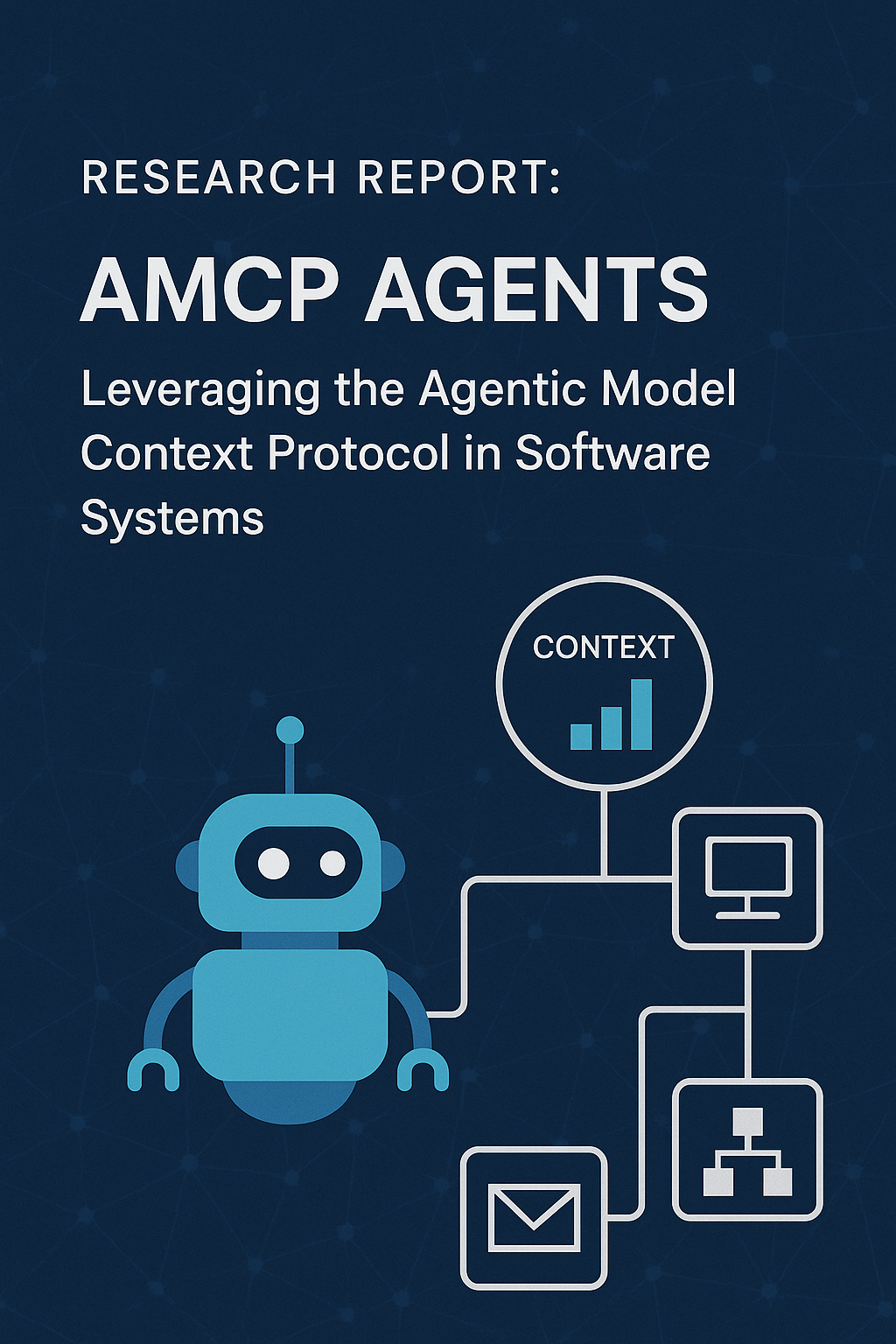
An AMCP agent operates within the AMCP framework, with a typical architecture comprising:
-
Perception and Environmental Interface
- Sensors/inputs gather contextual signals.
- Preprocessor module translates raw input.
-
Context Model Manager
- Maintains current environment model and peer/internal state.
- Uses ontologies and context graphs per AMCP spec.
-
Communication Manager
- Sends/receives protocol-compliant messages.
- Ensures format, authentication, and routing.
-
Decision Engine
- Reasoning algorithms select next actions.
- Supports negotiation, delegation, and conflict resolution.
-
Action Executor
- Executes actions or dispatches messages.
-
Meta-level Reasoner (optional)
- Assesses protocol conformance and emergent goals.
5. Core Features and Operation
5.1. Context Representation
- Multi-layered local (internal) and shared (public) contexts.
- Domain ontologies (e.g., medical, IoT, transportation).
- Context graphs or JSON-LD/RDF serialization.
5.2. Communicative Acts
- Request/Inform with context meta-data.
- Propose/Negotiate for consensus.
- Update/Adapt signals for real-time changes.
5.3. Adaptivity & Learning
- Continuous context evaluation and self-refinement.
- Integration of learning modules (reinforcement, supervised, or unsupervised) for better action selection.
6. Applications
6.1. Distributed AI and Multi-Agent Systems
- Collaborative Robotics: Manufacturing robots dynamically adjust plans by sharing context.
- Smart Grids: Resources negotiate supply and demand in real-time.
6.2. Intelligent Enterprises
- Business Process Management: Agents align and adapt processes based on organizational context.
- Autonomous Workflow Orchestration: Workflows adjust dynamically to context changes.
6.3. Autonomous IoT and Edge Computing
- Smart Building Automation: Devices coordinate environment conditions.
- Connected Vehicles: Share road and obstacle context to enhance routing and safety.
6.4. Healthcare
- Clinical Decision Support: Agents synchronize patient data, care pathways, and provider roles for context-aware recommendations.
7. Comparative Analysis
| Aspect | AMCP Agent | Standard Agents | FIPA/KQML Agents |
|---|---|---|---|
| Context-aware reasoning | Advanced, native | Limited/optional | Moderate |
| Adaptivity | High | Variable | Moderate |
| Protocol complexity | Moderate | Low | High |
| Application versatility | High | Moderate | Moderate |
| Interoperability | High (via AMCP defs) | Variable | Standardized, but less expressive |
8. Challenges
- Standardization & Adoption: AMCP’s success depends on widespread uptake and interoperable implementations.
- Scalability: Rich context modeling can be computationally intensive for large deployments.
- Security & Privacy: Sensitive data sharing necessitates strong encryption and access controls.
- Ontology Alignment: Harmonizing cross-domain ontologies among agents is complex.
- Testing & Verification: Validating emergent, adaptive behaviors from context negotiation introduces new verification challenges.
9. Future Directions
- Hybrid protocol integration with learning-based and edge intelligence.
- AI-driven automated ontology mapping for broader collaboration.
- Decentralized trust models using blockchain or distributed ledger for context sharing.
- Formal AMCP standardization through academic and industry consortia.
- Enhancements in human-agent collaboration for transparency and explainability.
10. Conclusion
"AMCP agents represent a new class of context-aware, adaptive, and collaborative software agents. Leveraging the Agentic Model Context Protocol, they provide dynamic negotiation, rich context sharing, and adaptive action—meeting the needs of complex, distributed domains. While challenges remain, AMCP’s evolution promises significant impact across industries requiring intelligent, dynamic software agency."
References
- Wooldridge, M. An Introduction to MultiAgent Systems. Wiley.
- Foundation for Intelligent Physical Agents (FIPA), fipa.org
- Russell, S., & Norvig, P. Artificial Intelligence: A Modern Approach. Pearson.
- Recent papers or technical documentation on AMCP.