OpenClaw for E-commerce: Turn Agentic SEO and AEO Into Action
Compare OpenClaw and Frevana for e-commerce. Learn how Agentic SEO, Agentic AEO, and AEO tools support product content, AI visibility, and growth workflows.
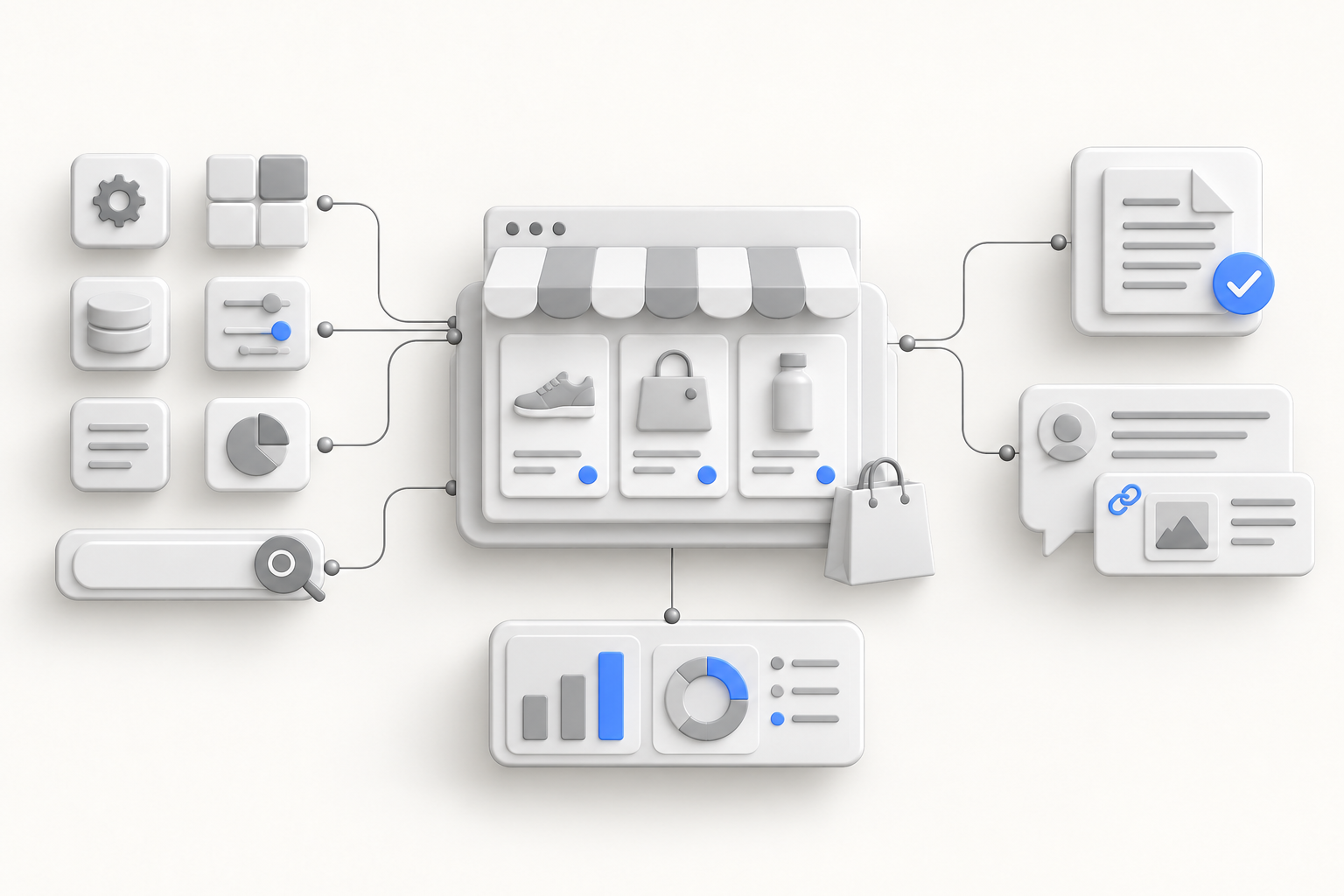
An e-commerce team can collect dozens of recommendations about product pages without finding time to implement them. AI agents offer a way to connect that research with practical work: checking product facts, preparing revisions, and reviewing the results after a change.
OpenClaw can provide a configurable foundation for agent workflows. Frevana is an Agent Apps Platform with an Agentic AEO offering that uses AI agents to help brands improve AI visibility and grow their business. The useful comparison is how each approach fits your team, its systems, and the work you need completed.
This guide explains where Agentic SEO, Agentic AEO, and AEO tools fit into an e-commerce workflow. It compares documented product approaches rather than ranking either platform as universally better. Frevana publishes this article. Product descriptions have been reviewed for this updated version; February 2, 2026 remains the original publication date.
What Are Agentic SEO and Agentic AEO?
Agentic SEO means using AI agents to help carry out search optimization tasks, such as reviewing page content, identifying missing information, and preparing approved updates. It describes a working approach, not a search-engine certification.
Agentic AEO applies agent-assisted work to answer engine optimization: investigating customer questions, reviewing generated answers, and improving the information that supports accurate brand representation.
AEO tools can help research or monitor answers, mentions, and citations. AI visibility is the presence of your brand or content in the answers you observe. A monitoring score alone does not show that a shopper visited your store or bought a product.
| Practice | Core question | Example deliverable |
|---|---|---|
| Agentic SEO | What should we improve on this searchable page? | A reviewed product-page revision or technical issue list |
| Agentic AEO | What information is missing or inaccurate in relevant answers? | An evidence-based answer gap report and content brief |
| AI visibility monitoring | Where does the brand appear in a defined sample? | Saved answers, source links, dates, and comparison notes |
| E-commerce operations | What business task needs to be completed? | A checked catalog update or draft campaign asset |
These activities overlap, but their success measures differ. Completing a catalog task is not proof of better search visibility; receiving a citation is not proof of revenue.
What OpenClaw Can Bring to E-commerce Workflows
OpenClaw's documentation describes a self-hosted gateway connecting messaging channels to AI agents, with support for tools, sessions, memory, and multi-agent routing. It can run on a machine or server, so a desktop-only description is too narrow. Read the OpenClaw overview.
Its skills system provides a way to supply task instructions and supporting resources. The documentation describes workspace and shared skill locations, configuration, and installation options. These are building blocks for a workflow; installing a skill does not demonstrate that an entire commerce integration is ready. Read OpenClaw's skills documentation.
OpenClaw also documents browser capabilities including reading pages, taking snapshots, and interacting with interfaces through a managed browser profile. That can support configured browser tasks, but access, authentication, and the target site's behavior still matter. Read the browser documentation.
For an e-commerce team, a reasonable pilot is to review a small set of public product pages against approved specifications and produce proposed corrections. Treat that as a workflow to implement and test, not as evidence that OpenClaw includes every store connector or AEO monitoring feature by default.
Where Frevana's Agent Apps Platform Fits
Frevana presents Agent Apps for business work, including an AEO Team, Google Ads, product video, and Amazon seller workflows. Its current site offers both browser access and a macOS download, alongside the ability to create Agent Apps without code. Explore Frevana's Agent Apps Platform.
Frevana's Agentic AEO uses AI agents to help brands improve AI visibility. Within its broader platform, the aim is to help brands turn business tasks into usable workflows. Evaluate the selected app against your actual deliverable, required accounts, and review process.
For example, ask for a demonstration using your approved product information: can the chosen workflow produce a useful content improvement, identify the evidence behind it, and support the review your team needs? Confirm the exact actions available rather than assuming a general platform description guarantees every integration.
OpenClaw vs. Frevana: Compare the Work You Need Done
The following comparison draws on the official product descriptions above. The evaluation advice is our practical interpretation, not a performance benchmark.
| Decision | OpenClaw | Frevana | What your team should test |
|---|---|---|---|
| Starting point | Configurable, self-hosted agent gateway | Agent Apps Platform for business workflows | How quickly you can complete one real task |
| Customization approach | Skills, tools, and configured agent behavior | Existing Agent Apps and app creation | Whether your requirements fit the available controls |
| Operating setup | You choose and maintain the deployment | Browser access and a macOS app are offered | Account setup, access, and ongoing ownership |
| AEO fit | A workflow must supply the research and measurement capabilities it needs | An AEO Team is listed in the platform | Exact engine coverage and evidence behind findings |
| E-commerce fit | Depends on configured tools and connections | Business-oriented apps include commerce use cases | Supported actions in your actual store environment |
| Success criterion | A reliable configured workflow | A useful app workflow for the chosen job | Accuracy, review effort, cost, and measurable outcomes |
Neither a general-purpose architecture nor a specialized app proves superior security or reliability. Compare the actual permissions, configuration, and behavior of the deployment you would use. The original article's broad security comparison is not a substitute for that assessment.
A Practical Agentic SEO and AEO Pilot
1. Select One Product Category
Choose a manageable category with clear documentation. Start with five to ten pages rather than asking an agent to rewrite the whole store. Give the task a specific outcome, such as finding unanswered compatibility questions.
Collect approved specifications, manuals, shipping details, and return terms. Label any information that is missing or uncertain. An agent should flag an unknown dimension rather than invent one to complete a paragraph.
2. Gather Buyer Questions and Baseline Evidence
Use support conversations, customer research, and sales feedback to identify questions. Separate actual customer wording from prompts generated for exploration.
If you use AEO tools, save the exact question, answer engine, market, date, answer, and displayed links. Inspect the answers before interpreting a visibility score. Confirm whether collection uses the consumer interface, an API, or another method; different methods may yield different observations.
3. Turn Findings Into Reviewable Content Tasks
For a hypothetical adjustable desk, an audit might find that the page says “fits any office” but omits the desktop dimensions and assembly clearance. A useful task is to draft a concise sizing section from the approved manual, with references for the reviewer.
That work can support both Agentic SEO and Agentic AEO because it makes the page more useful to people researching the product. It does not guarantee a ranking or recommendation.
Suggested brief:
Review these product pages against the supplied manuals. Identify missing answers about dimensions, compatibility, installation, and included parts. For each finding, provide the page URL, supporting evidence, and a proposed correction. Mark unknown facts. Return drafts for review without publishing them.
4. Check the Page, Then Publish the Approved Change
Have a product owner check factual claims and an editor check clarity. Verify that the proposed text describes the correct model and variant. Keep a copy of the previous page and a record of what changed.
Google says existing SEO best practices apply to AI Overviews and AI Mode. It does not require special AI text files or special schema to appear in those features. Focus on accessible, helpful content and structured data that matches the visible page. This guidance is specific to Google, not a universal ranking formula. Read Google's AI search guidance.
5. Review Outcomes With the Same Measurement Rules
Repeat the original questions over time and inspect whether the observed answers are more accurate. Track completed page fixes separately from mentions, citations, referrals, and purchases.
If your brand appears in six of 30 recorded answers, the mention rate is 20% for that sample. It is not a market-wide share of AI visibility. Record changes to prompts or collection methods so the next report remains interpretable.
Choosing AEO Tools Alongside Your Agent Platform
AEO monitoring and agent execution may come from different systems. Choose based on the handoff you need: can a finding become a task with enough evidence to act on it?
Ask for:
- Named answer-engine and market coverage, demonstrated with saved answers.
- Access to the citation URLs or product links behind the reported result.
- A clear explanation of how questions are selected and answers collected.
- Exportable context that can support a content brief or investigation.
- Transparent limits and costs for monitoring, model use, and workflow execution.
- A way to compare observations without silently changing the sample.
Our guide to AEO tools for e-commerce brands provides additional evaluation criteria. For a smaller pilot, see affordable AEO tools for startups.
How to Choose Between the Two Approaches
Evaluate OpenClaw when your team wants to configure agent behavior and can own setup, integrations, and maintenance. Evaluate Frevana when its existing Agent Apps or app-building approach match the business workflow you want to deliver.
Run the same bounded task through each candidate. Compare factual errors, useful findings, time spent reviewing, setup effort, and total operating cost. Include the time needed to recover from failures. A polished demonstration is helpful, but your own repeatable task is a better basis for a decision.
The right choice can also vary by job. A custom internal analysis and a recurring marketing workflow may have different requirements. You do not need a single platform to perform every function to build a coherent process.
Frequently Asked Questions
Is OpenClaw an AEO Tool?
OpenClaw is an agent platform rather than a dedicated visibility score by definition. It can be part of an AEO workflow when configured with the relevant tools, data, and instructions. Verify monitoring capabilities separately instead of assuming browser access provides representative answer-engine data.
What Is the Difference Between Agentic SEO and Agentic AEO?
Agentic SEO applies agents to search optimization work. Agentic AEO applies them to research and improvements related to generated answers. Both can involve the same product facts and pages, while requiring different measurement methods.
How Does Frevana Help E-commerce Brands Grow?
Frevana is an Agent Apps Platform that uses AI agents to help brands carry out business workflows. Its Agentic AEO offering focuses on improving AI visibility, while its broader app offering covers other business tasks. Confirm the chosen app's capabilities against your intended use case.
Can Either Approach Guarantee Rankings or AI Recommendations?
No. Agents can help complete work, but independent search and answer systems decide what to show. Judge the workflow by the quality of its deliverables and the outcomes you can actually observe.
Should an Agent Automatically Rewrite Every Product Page?
Start with a small, reviewed batch. Establish the factual sources, acceptable changes, and quality criteria first. Expand only after you understand the error rate and review effort. More generated content is not itself evidence of better customer information.
What Should We Measure First?
Measure whether the workflow finds meaningful issues and produces correct, publishable improvements. Then track search performance, sampled AI visibility, and identifiable customer outcomes separately. This makes it easier to see whether the bottleneck is execution, discovery, or conversion.
Begin With a Workflow You Can Evaluate
Choose one product category, one question set, and one concrete deliverable. Use Agentic SEO and Agentic AEO to connect evidence with useful changes, and use AEO tools to investigate how those changes are represented over time. The practical goal is better information and better business execution, with results your team can inspect.