How to Use Codex and GPT Image 2 to Create Better Brand Ads
An end-to-end workflow for researching creative trends, developing original campaigns, generating variations, and scaling assets across channels.
An end-to-end workflow for researching creative trends, developing original campaigns, generating variations, and scaling assets across channels.
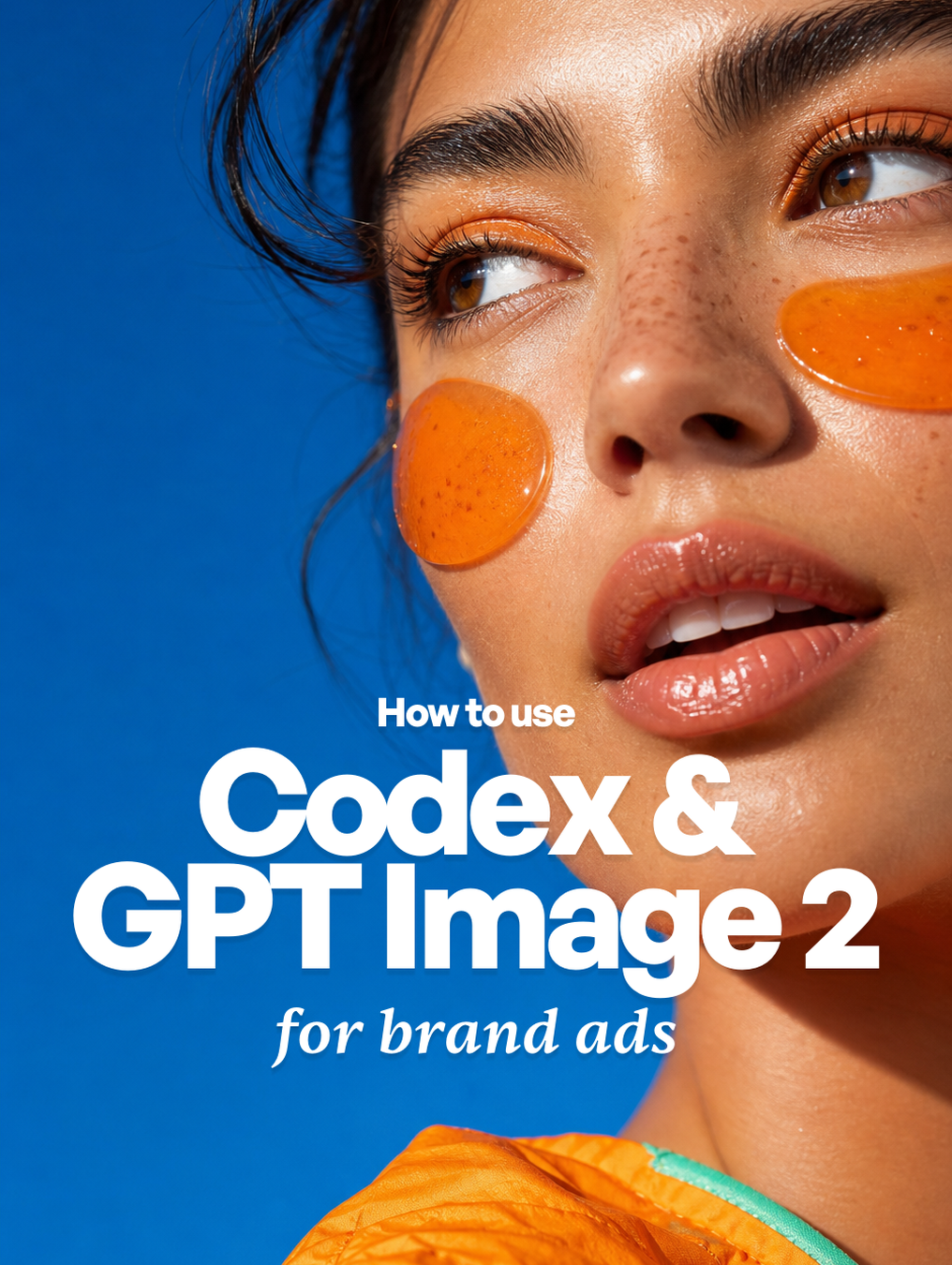
AI is changing how brands develop advertising creative. What once required multiple rounds of briefing, design, production, and resizing can now be approached as a more connected workflow—from research and concept development to asset creation and performance analysis.
But faster production does not automatically lead to better advertising. Generating dozens of attractive images without a strategy can produce more content without producing more results. Effective creative still depends on a relevant audience insight, a compelling offer, distinctive brand execution, and a disciplined testing process.
A stronger approach combines Codex for structured research workflows, creative planning, and automation with GPT Image 2 for image generation and editing. Together, they can help teams move from isolated creative experiments to a repeatable advertising production system.
This guide explains how to build that system—without copying competitors, compromising brand quality, or confusing creative volume with campaign performance.
What Each Tool Contributes
The two tools play complementary roles. Understanding the distinction makes the workflow easier to manage.
| Tool | Primary role | Practical applications |
|---|---|---|
| Codex | A coding agent that helps build and operate structured workflows | Organizing authorized ad research data; creating briefs and prompt templates; generating asset manifests; writing scripts for resizing, naming, and quality checks; preparing testing reports |
| GPT Image 2 | An AI model for generating and editing images | Exploring campaign directions; creating product and lifestyle compositions; editing supplied visual references; producing variations for different creative concepts and placements |
| Human creative and marketing team | Strategy, judgment, approval, and measurement | Validating insights, defining positioning, checking product accuracy, reviewing legal and platform requirements, selecting ads, and making budget decisions |
The principle is simple: use AI to accelerate execution, while keeping strategy, originality, and final approval in human hands.
Step 1: Research Competitor Advertising and Identify Useful Patterns
Start with observation, not generation.
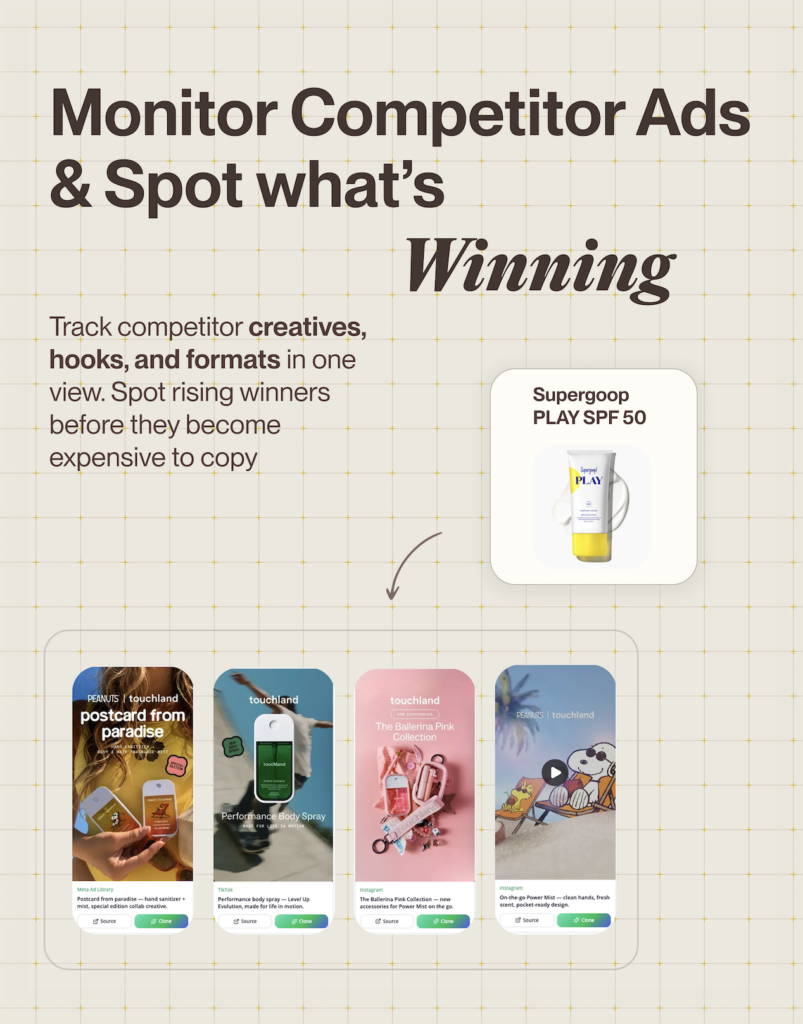
Review publicly available ads from direct competitors, adjacent categories, and brands that serve similar audiences. Useful sources may include official advertising libraries, brand websites, newsletters, and social content. Work only with information you are permitted to access, and record where each example came from.
Rather than collecting screenshots without context, build a structured creative research library. Codex can help you write scripts to normalize approved exports, categorize observations, and turn your notes into a searchable table.
| Research dimension | Questions to ask |
|---|---|
| Creative format | Is it a product close-up, lifestyle photograph, comparison, testimonial, or demonstration? |
| Opening hook | What problem, aspiration, curiosity, or benefit captures attention? |
| Audience | Who is the message speaking to, and in what situation? |
| Value proposition | What is the primary reason to choose this product? |
| Offer and CTA | Is there a bundle, launch, trial, discount, or direct purchase invitation? |
| Visual system | How are color, composition, typography, and product prominence used? |
| Distribution | Which placements or formats appear to be in use? |
| Observed signals | How long has an ad been visible? Are there multiple versions or recurring themes? |
Distinguish observations from actual performance
An ad appearing repeatedly may be worth studying, but frequency or longevity is not proof of profitability. Creative may remain active for reasons unrelated to performance, and public libraries generally do not reveal conversion rates, customer acquisition costs, or return on ad spend.
Use the evidence to form hypotheses, not to declare a competitor's ad a confirmed winner. For example: “This brand repeatedly emphasizes portable packaging; portability may be an important customer motivation.”
Suggested output: a creative research database with source links, dates observed, messaging categories, and testable hypotheses.
Step 2: Translate Effective Patterns Into Original Brand Concepts
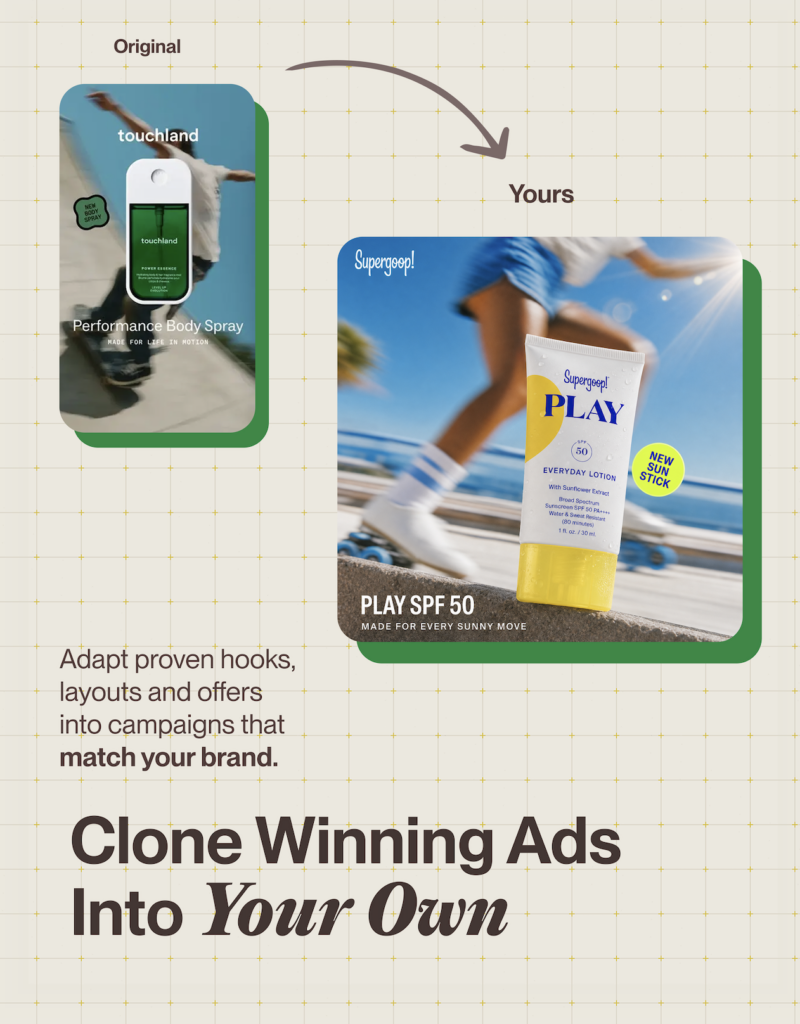
The goal of competitor research is not to reproduce someone else's advertisement. It is to understand the underlying creative principles and apply them to an original idea grounded in your product and audience.
Begin with a short brand brief: your product, target customer, differentiation, approved claims, visual guidelines, current offer, and desired action. Then evaluate patterns against those constraints.
| Pattern observed | Original interpretation for your brand |
|---|---|
| Product shown in motion | Demonstrate an authentic use case in your customer's daily routine |
| Seasonal campaign | Build an original campaign around your audience's seasonal needs |
| Creator-style demonstration | Show a credible, authorized demonstration using your own product |
| Dramatic packaging close-up | Highlight your product's distinctive shape, materials, and identity |
| Before-and-after comparison | Use a compliant, substantiated demonstration only where appropriate |
| Problem–solution narrative | Lead with a specific customer friction and your product's supported benefit |
Example Codex brief-development prompt
I am creating an original paid-social campaign for [brand]. I will provide a brand brief and a set of legally obtained competitor ad observations. Organize the ads by audience, hook, visual structure, offer, and call to action. Separate direct observations from performance hypotheses. Identify five recurring creative patterns, then propose six original concepts that express our brand's positioning without reusing any competitor's wording, logos, distinctive compositions, or visual assets. For each concept, provide a headline, customer insight, visual direction, required product assets, primary CTA, claim-verification notes, and a suggested A/B test. Return the results as a Markdown table and a machine-readable CSV.
A useful brief should answer three questions before production starts: Who is this for? What should they understand or feel? What action should they take?
Step 3: Generate On-Brand Visuals With GPT Image 2
Once a concept is approved, use GPT Image 2 to explore its visual execution. A precise prompt usually produces a more usable starting point than a vague request to “make a premium ad.”
Include the following elements in each creative prompt:
- Product: What must appear, including packaging, color, and approved visual references.
- Audience and context: Who the ad is for and the situation being depicted.
- Composition: Product placement, focal point, camera angle, and negative space.
- Art direction: Lighting, palette, setting, styling, and intended mood.
- Placement: Target orientation or aspect ratio and any safe-area requirements.
- Restrictions: What must remain unchanged, and what should not appear.
Example: A summer sunscreen campaign
Consider a fictional sunscreen brand preparing a campaign for outdoor enthusiasts. Its positioning emphasizes convenient daily use, and its visual identity uses blue, white, and warm neutrals.
Example GPT Image 2 prompt:
Create an original premium lifestyle advertisement for a fictional sunscreen brand aimed at active adults. Use the provided approved product photograph as the packaging reference. Place the product prominently in the lower-right foreground of a sunlit outdoor tennis setting. Show an energetic but natural summer atmosphere, warm directional light, crisp blue sky, refined editorial photography, and realistic skin texture. Maintain a clean blue-and-white palette and reserve uncluttered space in the upper-left for a headline and CTA to be added later. Create a vertical 4:5 composition. Preserve the supplied product's recognizable shape and visible branding as closely as possible; do not invent extra product claims, certifications, or labels. Do not include any competitor logos or slogans.
Production tip: use approved product photography and brand assets as references when possible. AI-generated packaging, small label text, and fine product details still require close review. For critical logos, legal copy, and CTAs, it is often safer to apply final text and brand elements during a separate design or compositing step rather than relying on a generated image alone.
Treat the first generation as a draft. Review the composition, edit weak areas, and approve a master creative before producing a large set of variations.
Step 4: Build a Structured Creative Testing Matrix
The value of AI is not simply that it can produce many images. It is that it makes it easier to explore meaningful, controlled differences between creative ideas.
Instead of creating hundreds of random variants, define the dimensions you want to test.
| Variable | Example options | Question being tested |
|---|---|---|
| Hook | Convenience; lifestyle aspiration; product benefit | Which opening message earns attention? |
| Scene | Tennis court; beach bag; city commute | Which context feels most relevant? |
| Audience | Athletes; travelers; daily skincare users | Which use case resonates? |
| Offer | Product launch; bundle | Which proposition motivates action? |
| Art direction | Editorial; playful; product-led | Which execution best represents the brand and drives response? |
For example, three hooks × three settings × two offers = 18 combinations. That is a manageable starting library, not a requirement to launch 18 ads at once. Increase variety only when the added concepts have a clear reason to exist.
Codex can help create a production manifest containing creative IDs, prompts, sizes, output paths, review status, and test hypotheses. It can also write scripts to organize outputs and flag missing formats. Generation time and cost will vary with image complexity, service availability, and the number of iterations; producing a large library is not necessarily instantaneous.
Example Codex production-automation prompt
Based on this approved creative matrix, generate a CSV manifest with one row per concept and fields for campaign, audience, hook, scene, offer, aspect ratio, image prompt, source assets, filename, and approval status. Then write a script that organizes approved outputs into placement-specific folders and validates expected dimensions. Do not overwrite source files. Generate a summary of missing files and items that still require human review.
The result is a traceable creative library rather than a folder of unexplained image files.
Step 5: Adapt Approved Concepts to Each Advertising Placement
A concept that works in a vertical story may require more than a crop to perform well in a website banner. Layout, headline placement, product scale, and available reading time all change by placement.
| Placement | Common starting aspect ratio | Creative consideration |
|---|---|---|
| Instagram Stories and Reels | 9:16 | Keep essential text and the CTA away from interface overlays |
| TikTok vertical creative | 9:16 | Prioritize a mobile-first, immediately understandable visual |
| Instagram or Meta feeds | 1:1 or 4:5 | Make the product and central message legible on a small screen |
| Website hero or display banner | 16:9 or placement-specific | Preserve a clear visual hierarchy and room for page copy |
| Email hero | Custom responsive dimensions | Optimize image weight, readability, and mobile rendering |
| Landing-page section | 4:5, 16:9, or custom | Match the page layout and position visuals near supporting proof and CTA |
These are planning guidelines, not universal platform requirements. Check current placement specifications and safe areas before exporting or launching a campaign.
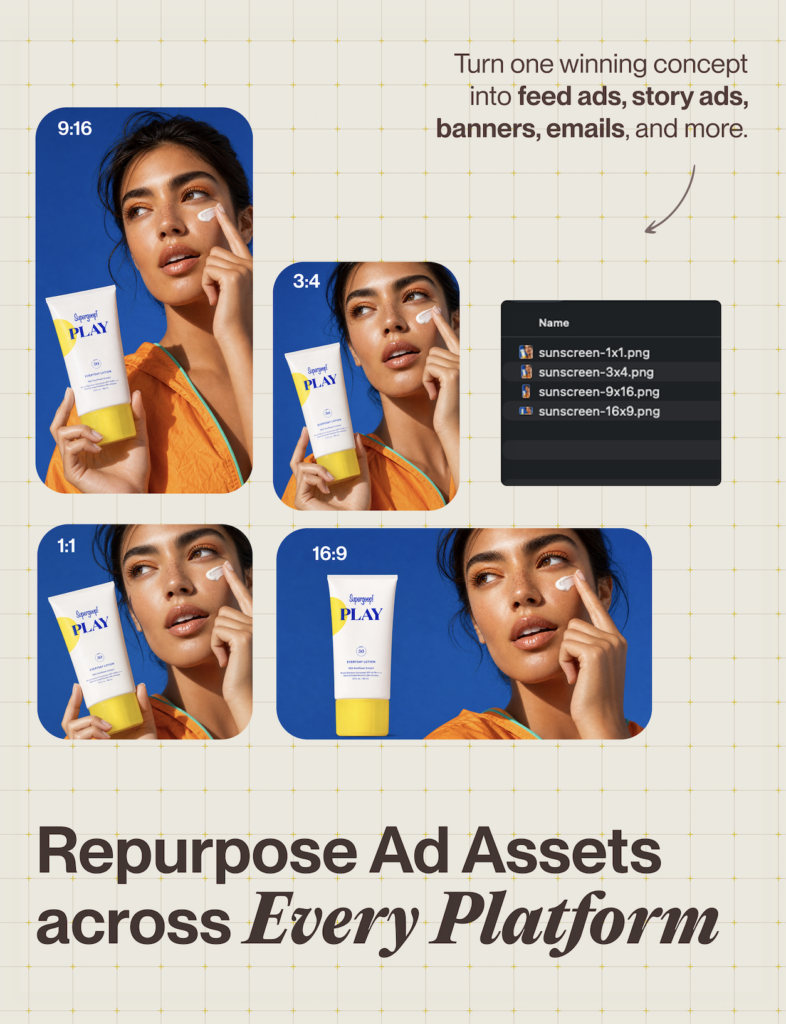
Use GPT Image 2 to recompose an approved concept where needed, rather than stretching it or cropping away the product. Codex can help automate dimension checks, naming conventions, export organization, and quality-control reports.
One creative idea can become a coordinated family of assets—but each version should still be reviewed for the experience in which it will appear.
Step 6: Test, Learn, and Improve the Next Creative Batch
Production is only half the workflow. What turns creative output into a repeatable growth process is measurement.
Launch a focused group of approved concepts, keep your test objective clear, and record results against the hypothesis that motivated each ad. Avoid changing too many variables at once when you need to understand why performance differs.
| Metric | What it can help you understand |
|---|---|
| Thumb-stop or early attention signals | Whether the opening creative earns initial attention, where available |
| Click-through rate (CTR) | Whether the creative and message encourage people to explore further |
| Conversion rate | Whether traffic generated by the ad takes the intended action |
| Cost per acquisition (CPA) | How efficiently the campaign generates new customers or leads |
| Return on ad spend (ROAS) | How attributed revenue compares with advertising spend |
| Frequency and creative fatigue | Whether repeated exposure may be reducing responsiveness |
Interpret metrics in context. Audience targeting, landing-page quality, attribution windows, budget, and seasonality can influence outcomes independently of the creative itself.
Codex can help process approved performance exports, compare results by hook or visual angle, and generate a concise learning report. The final decision about which concepts to scale should take into account business goals, sample size, measurement quality, and profitability—not a single vanity metric.
Over time, the team develops a feedback loop:
Research → Original concept → Visual production → Placement adaptation → Testing → Learning → Next iteration
A Practical Workflow at a Glance
| Phase | Main activity | Deliverable |
|---|---|---|
| 1. Research | Review authorized market and competitor examples | Creative insight library |
| 2. Strategy | Convert observations into original campaign hypotheses | Approved concept briefs |
| 3. Create | Generate and refine visuals using GPT Image 2 | Master creative assets |
| 4. Vary | Build controlled versions with a documented testing plan | Creative matrix and production manifest |
| 5. Distribute | Adapt assets to placements and check specifications | Channel-ready files |
| 6. Optimize | Analyze campaign outcomes and document learnings | Performance review and next creative brief |
Brand Safety and Quality-Control Checklist
Every AI-assisted creative should pass a final review before publication.
| Review area | What to verify |
|---|---|
| Product accuracy | Shape, packaging, proportions, labels, colors, and demonstrated functionality match the actual product |
| Brand consistency | Fonts, tone, palette, imagery, and visual hierarchy follow brand guidelines |
| Originality and permissions | Assets are original or properly licensed; no unauthorized third-party IP, logos, or recognizable likenesses are included |
| Claims and substantiation | Product, performance, health, environmental, and comparative claims can be supported |
| Testimonials and endorsements | Any endorsements are authentic, authorized, and accompanied by required disclosures |
| Visual integrity | Hands, faces, objects, reflections, text, and product interactions are plausible and appropriate |
| Text accessibility | Headlines, disclosures, and calls to action remain legible on mobile |
| Placement compliance | Dimensions, safe areas, content rules, and file specifications match the channel |
| Data handling | Customer information and proprietary source materials are used only with appropriate permission and safeguards |
| Approval record | A responsible person has signed off on the final asset and its intended use |
For regulated products—such as sunscreen, skincare with specific efficacy claims, financial services, or health-related offerings—apply the relevant industry and jurisdictional requirements as well as each platform's advertising policies.
How Frevana Approaches AI-Powered Ad Production
At Frevana, the opportunity is bigger than generating individual images. The goal is to make the full creative process more structured, flexible, and repeatable.
In this approach, Codex helps define and automate the operational work surrounding a campaign: organizing research, producing creative briefs, preparing prompts, maintaining asset specifications, and supporting analysis. GPT Image 2 supports the visual side: developing original campaign imagery, refining compositions, and exploring approved variations.
Together, these capabilities point toward a more efficient model of creative production—one in which teams can spend less effort on repetitive execution and more time on the decisions that matter: understanding customers, expressing a differentiated brand, and learning what actually performs.
AI does not replace brand strategy or creative judgment. It helps capable teams put those strengths to work more consistently and at greater scale.
Frequently Asked Questions
Can I use competitor advertisements as inspiration?
Yes. Publicly available ads can help you identify messaging conventions, creative formats, and audience themes. However, you should not reproduce protected visuals, distinctive compositions, slogans, trademarks, or other proprietary assets. Use the research to formulate an original concept for your brand.
Is Codex an ad-design or image-generation tool?
Codex is primarily a coding agent. In this workflow, its strength is building structured processes around creative work—such as organizing datasets, generating manifests and briefs, writing asset-processing scripts, and helping analyze exported results. GPT Image 2 handles image generation and editing.
Can GPT Image 2 generate usable product advertisements from a prompt?
It can produce useful first drafts, variations, and edited compositions. Final advertisements still need human checks for packaging accuracy, logos, readable text, substantiated claims, and platform requirements. Using approved reference assets generally improves consistency.
How many ad variations should I create?
Start with enough variations to test a specific hypothesis. A small, well-designed set of distinct concepts is often more informative than a large collection of nearly identical images. Expand the library when early results show which directions deserve further testing.
What aspect ratios should I use?
For initial planning, 9:16 works for many full-screen vertical placements, 1:1 and 4:5 are useful for many feed placements, and 16:9 can work for horizontal banners and website sections. Always validate the exact current specifications for the intended placement.
How do I know whether an AI-generated ad is effective?
Evaluate it through campaign testing using metrics aligned with your objective, such as click-through rate, conversion rate, CPA, and ROAS. An appealing image or a competitor's apparent ad longevity is not enough to establish performance.
What is the most common mistake in AI ad production?
Treating image generation as the entire strategy. Without audience insight, differentiated messaging, quality control, and measurement, faster production can simply create more unproductive assets.
Final Takeaway
The most effective application of AI in advertising is not “generate more ads.” It is “build a better system for creating, evaluating, and improving original advertising.”
Codex can help make the process organized and repeatable. GPT Image 2 can help make creative exploration faster and more flexible. When combined with brand strategy, rigorous review, and real performance data, they give marketing teams a practical foundation for scaling creative work without losing control of quality.
Further reading: OpenAI Codex · GPT Image 2 model documentation · OpenAI image generation guide