Amazon AEO: Prepare Your Brand for Alexa for Shopping
Build an Amazon AEO strategy for Alexa for Shopping. Use AEO tools, clearer product listings, and a practical checklist to support your brand's AI visibility.
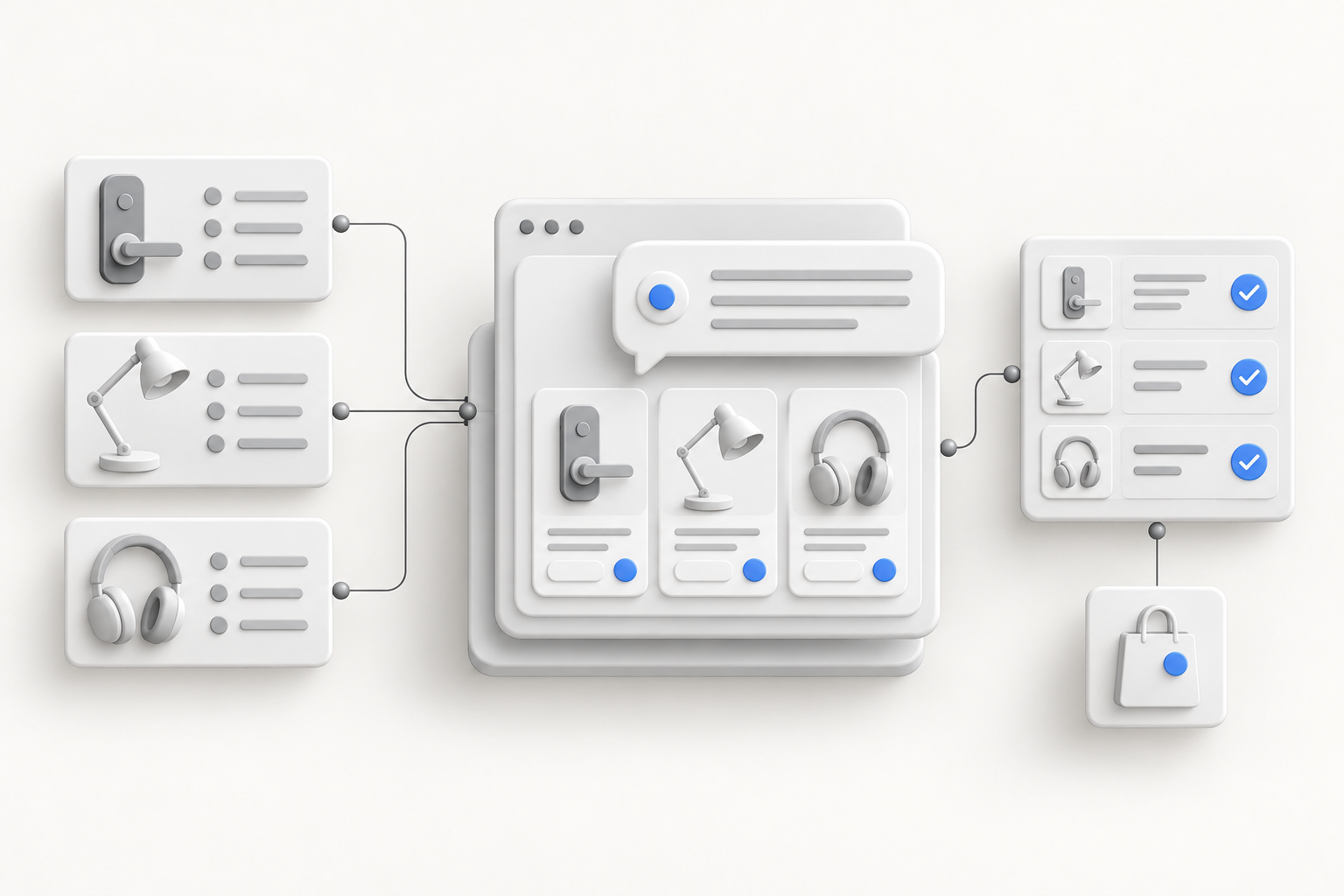
A shopper looking for a smart lock may need to know whether it fits an existing door, requires drilling, or works with a particular home setup. A keyword-heavy product title cannot answer all of those questions.
Alexa for Shopping makes conversational product discovery a practical concern for e-commerce brands. The opportunity is to provide clear, accurate information that helps buyers evaluate your products. AEO tools can support research, content review, and measurement, but they do not control Amazon's recommendations.
This Amazon AEO guide explains how to improve product information, choose relevant AEO tools, and build a repeatable workflow for AI visibility. Start with the facts buyers need to compare products and make confident decisions.
What Is Alexa for Shopping?
Alexa for Shopping is Amazon's AI shopping experience. Amazon describes it as combining product knowledge and shopping history with the personalized context of Alexa+. Its announced capabilities include conversational questions, product comparisons, shopping guides, and price tracking in the Amazon Shopping app and website, with shopping also available on Echo Show. Amazon's launch announcement specifies U.S. availability and says app and website access does not require Prime or an Echo device. Check local availability before assuming the same experience in every market. Read Amazon's Alexa for Shopping announcement.
The original version of this article used Amazon's earlier assistant name. Amazon confirms that it renamed that experience Alexa for Shopping on May 13, 2026. This guide uses the current name. See Amazon's naming update.
Amazon has since expanded the experience to include actions such as editing shopping lists, managing eligible subscriptions, and checking refunds. Its current description also includes product research, comparisons, and shopping-history-based personalization. These are shopper capabilities, not a seller ranking formula. Read Amazon's latest capabilities update.
Why AI Visibility Matters for E-commerce Brands
Conversational shopping lets people express requirements that are difficult to capture in a short query. They can describe their situation, compare options, and ask follow-up questions before visiting several product pages.
That changes the content questions a brand should ask:
- Can a shopper identify the exact version or model being described?
- Are compatibility requirements and limitations easy to find?
- Do specifications agree across the listing, images, manual, and brand website?
- Does the content explain the use case instead of relying on broad claims?
Our practical inference is that accurate, detailed product information makes these conversations easier to support. It does not establish that any particular wording increases the likelihood of an Amazon recommendation. Amazon's public product announcements do not provide a guaranteed optimization recipe.
Traditional search, merchandising, advertising, and product quality still matter. AEO adds another way to inspect whether customers receive useful information about your brand.
What Is Amazon AEO?
Amazon AEO is answer engine optimization applied to product discovery and buying questions in Amazon’s AI shopping experience. In this guide, the term describes researching shopper questions, improving product facts, and reviewing how Alexa for Shopping represents your products. It is a marketing practice, not an Amazon certification or a guarantee of recommendations.
Keep three outcomes separate:
| Outcome | What it tells you | What it does not establish |
|---|---|---|
| Brand or product mention | Your name appears in an observed answer | A recommendation, visit, or purchase |
| Product recommendation | The answer suggests an item for a stated need | That every customer sees the same suggestion |
| Citation or product link | The response points to a source or item | A universal ranking or measured conversion |
Do not force Amazon's shopping interface into a generic citation metric. Record the links and product cards it actually displays, and distinguish those observations from citations collected in other answer engines.
Better Product Information Starts With Better Questions
Begin with questions from support conversations, returns, reviews, and customer research. Use them to identify confusion, then verify the answer against approved product documentation.
| Shopper question | Useful information to provide | Weak content to replace |
|---|---|---|
| Will this lock fit my door? | Supported lock types, dimensions, installation requirements | “Fits any home” |
| Can this treadmill fit under my desk? | Product dimensions, operating clearance, storage dimensions | “Perfect for small spaces” |
| Does this lamp work without an outlet? | Power source, included accessories, battery details if applicable | “Use anywhere” |
| Will these headphones connect to my computer? | Supported connection methods and relevant compatibility limits | “Universal connectivity” |
| Can I wash this cover? | Material, washing instructions, drying restrictions | “Easy care” |
These are examples of information to gather, not product claims to copy. If you do not have evidence for a specification, obtain it before publishing.
For a hypothetical retrofit smart lock, a useful description might say that it attaches to specified existing deadbolts and requires a compatibility check. That is more informative than “the best smart lock for every renter,” which hides important conditions.
An Amazon AEO Strategy in Three Steps
Step 1: Discover the Questions That Affect Buying Decisions
Choose one product category and a manageable question set. Include questions about discovery, comparison, compatibility, installation, and ongoing use.
Prioritize questions where a wrong or incomplete answer could prevent a suitable purchase or lead to an unsuitable one. Avoid building a large keyword list that your team cannot map to actual product information.
Use AEO tools to support question research where their data is relevant. Check how suggested questions were collected; a generated prompt is not automatically evidence of customer demand.
Step 2: Audit the Product Facts You Control
Review the product title, attributes, description, supporting images, manuals, and brand-owned help content. Check for missing details, contradictions, outdated versions, and unsupported claims.
Separate your control over Amazon listing content from your control over your own website. Sellers can work with available catalog fields and content tools; they do not control Amazon's site-wide crawling rules, templates, or internal recommendation systems. Do not treat an external website audit as proof that Alexa for Shopping can or cannot access an Amazon listing.
Create a short issue log with the question, missing fact, source of truth, owner, and proposed change. Resolve product uncertainty before asking an agent or writer to polish the wording.
Step 3: Improve, Review, and Observe
Update eligible listing fields and supporting content through your normal review process. Use direct language, accurate specifications, and meaningful limitations. Keep images and written claims consistent.
For your own website, publish helpful setup guidance, compatibility explanations, or comparisons where appropriate. Do not assume an off-Amazon page will be selected as a source simply because it repeats the product name.
After changes are live, revisit the same shopper questions. Record what the experience shows, whether the answer is accurate, and which products or sources appear. Repeat observations over time rather than treating one response as a performance verdict.
How to Choose Amazon AEO Tools for AI Visibility
When evaluating Amazon AEO tools, start with the work your team needs help completing: shopper-question research, product-content review, or answer monitoring. Evaluate each platform against your actual workflow and confirm its Amazon coverage.
| Need | Capability to evaluate | Question to ask the provider |
|---|---|---|
| Understand customer questions | Research with clear source context | Are these observed queries, inferred topics, or generated prompts? |
| Review product content | Page-level findings and inspectable evidence | Can we trace a recommendation to a specific missing fact? |
| Monitor answer engines | Named engine coverage and repeatable collection | Do you monitor Alexa for Shopping directly, or other platforms? |
| Compare outcomes | Saved answers, dates, markets, and relevant context | Can we inspect the answer behind the score? |
| Prepare improvements | Drafting or agent-assisted tasks | Can we use approved product facts and review changes before publishing? |
Do not assume that a platform tracking ChatGPT or Google AI answers also measures Alexa for Shopping. Ask for a demonstration of the exact surface and market you need. If it does not cover Amazon's shopping experience, use it for the work it supports and keep Amazon observations separate.
For a broader comparison, see our guide to AEO tools for e-commerce brands.
Where Frevana's Agentic AEO Fits
Frevana's Agentic AEO uses AI agents to help brands improve AI visibility. Its broader Agent App offering includes an AEO Team. For an e-commerce workflow, evaluate agent assistance against a defined task, such as organizing shopper questions or preparing a product-content improvement for review. Explore Frevana.
Provide approved specifications, current product documentation, and a clear scope. Ask which tasks the selected workflow supports and how your team can review the output. Confirm direct monitoring capabilities separately; agent assistance does not itself establish access to Alexa for Shopping data.
Frevana publishes this article. Its role here is to describe an agent-assisted approach, not to claim that using the platform guarantees Amazon recommendations.
A Practical AI Visibility Measurement Plan
Start with one product category and a stable set of questions. Record the marketplace, date, interface, exact wording, relevant conversation context, answer, and displayed product links.
Amazon describes personalization based on shopping activity and conversations, so differences between observations may reflect context as well as content changes. Keep that limitation visible in your reporting. See Amazon's description of personalization.
Track these measures separately:
- Product presence: Whether the observed answer names or displays the relevant item.
- Recommendation fit: Whether the item actually meets the shopper's stated requirements.
- Answer accuracy: Whether specifications and limitations are represented correctly.
- Displayed sources: Product links or source references shown in the response.
- Business performance: Available traffic, sales, conversion, and return data from your normal reporting.
If a product appears in six of 20 recorded answers, report that as a 30% presence rate in that sample. It is not a market-wide share of AI visibility. Similarly, do not label a sales increase as Alexa-driven unless your reporting provides evidence for that attribution.
Amazon AEO Product Content Checklist
- Confirm the product name, model, and variant match across materials.
- Verify dimensions, materials, compatibility, and included accessories.
- Explain who the product fits and when it may not be suitable.
- Answer important installation, maintenance, and use questions.
- Remove outdated prices, unsupported superlatives, and contradictory claims.
- Check that screenshots and product images represent the current item.
- Assign an owner to review facts when the product changes.
- Save a baseline and a change log before measuring again.
AEO should improve the customer's understanding of the product. It should not encourage invented specifications, fabricated reviews, or instructions embedded in a listing to manipulate an assistant's behavior.
Frequently Asked Questions
How Does Amazon AEO Differ From Amazon SEO?
Amazon SEO focuses on product discoverability in search results. Amazon AEO focuses on how product information answers conversational shopping questions and supports accurate representation in AI responses. Both benefit from clear, complete product facts; neither replaces product quality or a good customer experience.
What Is Alexa for Shopping?
It is Amazon's conversational AI shopping experience, which supports product research, comparisons, recommendations, and other shopping tasks. Availability and capabilities should be checked for the customer's market and interface. Read Amazon's overview.
Does AEO Guarantee That Alexa for Shopping Will Recommend My Product?
No. Accurate information can help customers understand your offering, but brands and third-party AEO tools do not control Amazon's recommendations. Treat content improvements as testable work, not a guaranteed placement strategy.
Which AEO Tools Can Track Alexa for Shopping?
Frevana Amazon AEO helps brands track and improve their Amazon AEO performance for Alexa for Shopping. The agent app uses AI agents to support ongoing monitoring and optimization, helping brands understand their AI visibility and improve how their products are represented in Amazon's shopping experience.
Should I Add More Keywords to My Amazon Listing?
Use clear product language where it helps customers understand the item. Repetition cannot replace missing dimensions, compatibility details, or limitations. Prioritize accurate answers and follow the applicable listing requirements.
Can I Add Schema or Change Amazon's Crawling Settings?
You do not control Amazon's site-wide technical implementation. Focus on the product information and content fields available to you. Technical work on your own website is a separate activity and should not be presented as a change to Amazon's internal systems.
Is Agentic AEO the Same as Automated Listing Publishing?
No. Agentic AEO describes using agents to help with optimization work. Publishing access and approval steps depend on the specific workflow. Confirm what it can do, provide reliable source material, and review product claims before publication.
Where Should a Small Brand Start?
Choose one product and the questions buyers most often ask about it. Correct the largest information gaps, document the changes, and review a consistent sample of answers. Expand only when the process produces useful findings your team can act on.
Make Your Product Easier to Understand and Evaluate
An Amazon AEO strategy starts with clear, complete, and consistent product facts for Alexa for Shopping. Start with real customer questions, fix the information you control, and use AEO tools where their capabilities match your needs. The practical goal is accurate representation and better buying decisions, measured with evidence rather than promises.