AI Agents vs. Frevana Agentic Apps
AI Agents vs. Frevana Agentic Apps
An AI Agent can reason and act. It can interpret a goal, decide what to do next, use tools, and carry a task forward. A Frevana Agentic App takes that capability and turns it into an app experience: something people can see, use, share, and reshape.
That is the whole distinction in brief. The rest of this article unpacks it through three central differences: the interface, the relationship between the app and the Agent that powers it, and the way Agentic Apps are created, shared, and customized over time.
First, What Is an AI Agent?
An AI Agent is a system built around a language model that can pursue a goal rather than simply answer a single prompt. Most Agents share four ingredients:
- A model that interprets instructions, reasons about the task, and decides on next steps.
- Tools that let it act beyond generating text, such as searching, reading files, or calling external services.
- State, meaning the context it carries forward: what has been done, what was learned, and what remains.
- Control, the loop that decides when to plan, when to act, when to check results, and when to stop.
This is genuinely powerful. But an Agent, on its own, is a capability. How people experience that capability, follow it, and pass it along is a separate question. That is where Agentic Apps come in.
Difference One: An App UI Makes the Work Visible
Most people meet AI Agents through chat. Chat is a natural starting point: you type a request, the Agent responds, and the conversation continues. For quick questions, that is often enough.
For real work, chat has limits. A conversation is a linear transcript. The steps an Agent took, the inputs it relied on, and the intermediate results it produced all scroll past in a single stream. If you want to see where a task stands, revisit a particular step, or understand how a result was reached, you are left digging back through messages. The structure of the work exists, but the interface does not show it.
An Agentic App contains an app UI. Instead of hiding the work inside a conversation, it can present that work in a form designed for the task at hand. Inputs can sit where inputs belong. Progress can be shown as progress. Outputs can be laid out so they are easy to read and review. The workflow becomes something you can look at, not something you have to reconstruct from memory.
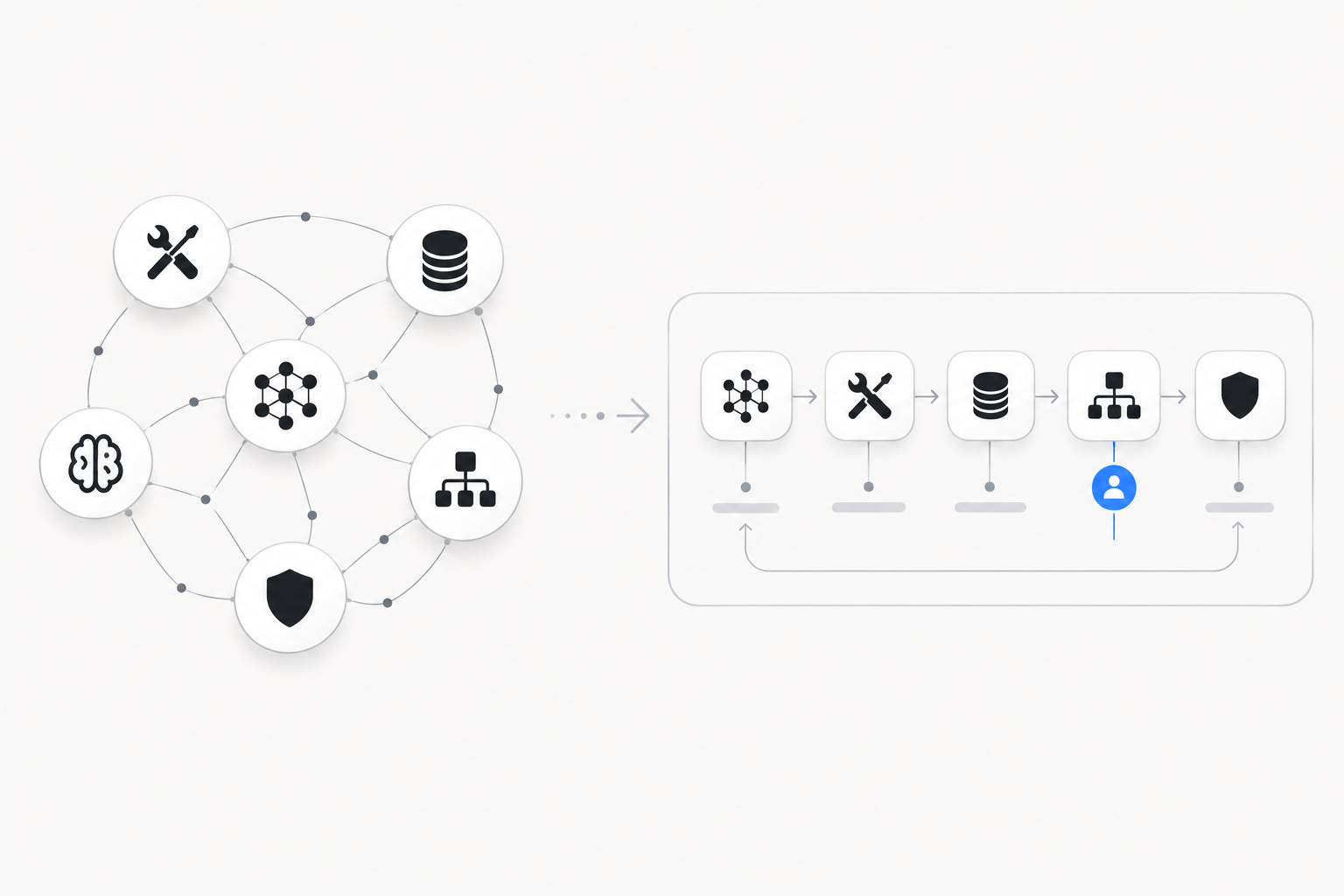
This matters for two reasons. The first is workflow visualization: when people can see how a task unfolds, they understand it better, trust it more appropriately, and notice sooner when something needs attention. The second is user experience: a purpose-built interface asks less of the person using it. They do not need to know the right prompt or remember what the Agent did three messages ago. The app holds that structure for them.
Chat is a general-purpose window onto an Agent. An Agentic App is a window shaped around a specific kind of work.
Difference Two: Agentic Apps Are Powered by Agents
It would be easy to read “Agents vs. Agentic Apps” as a contest, as if one must replace the other. That is not the relationship. Agentic Apps are powered by Agents, and that is precisely why they can get work done.
The interface alone does not think. It does not reason through a problem, choose which tool to use, or adjust when a step returns something unexpected. The Agent does that. Inside an Agentic App, the Agent remains the intelligence and execution layer: it interprets the task, takes action, and produces results. The app gives that capability a form people can work with.
An Agentic App is not an alternative to an Agent. It is an Agent given an interface.
This distinction separates Agentic Apps from ordinary software forms or static templates. A form collects information and passes it along. An Agentic App collects information and then hands it to an Agent that can actually act on it. The result is not just a nicer way to describe a task; it is a way to have the task carried out.
So the useful comparison is not which one is better. It is what each layer contributes. The Agent contributes reasoning and action. The app contributes visibility, usability, and a shape that other people can pick up.
Difference Three: Easy to Create, Easy to Share, Open to Customization
The third difference concerns what happens around the app: how it comes into being and how it travels.
Creation through vibe coding
Frevana Agentic Apps are very easy to create through Frevana vibe coding. Vibe coding means building by describing what you want rather than writing traditional code line by line. The person creating the app focuses on the intent—what the app should help someone do—instead of on implementation details. That lowers the barrier to turning a useful Agent capability into an app experience.
Sharing as a link
Once created, an Agentic App is easy to share as a link. The comparison to a meeting link is deliberate, and it is explored more fully below. The short version: sending an Agentic App should feel as ordinary as sending someone an invitation to join a call.
Customization by recipients
More importantly, anyone who receives the link can further customize the Agentic App. The recipient is not limited to using it exactly as delivered. They can adapt it to their own needs, which is what allows an Agentic App to evolve through reuse.
The Three Differences at a Glance
| Difference | AI Agent (typical chat experience) | Frevana Agentic App |
|---|---|---|
| Interface | Chat-only; the workflow lives inside a linear conversation. | An app UI that provides better workflow visualization and user experience. |
| Relationship | The intelligence and execution layer that reasons and acts. | Powered by an Agent, so it can get work done through an interface. |
| Creation and sharing | Experienced mainly by whoever is in the conversation. | Easy to create through vibe coding, shared as a link, and customizable by anyone who receives it. |
How the Relationship Works
It helps to picture the two layers working together. When someone opens an Agentic App, they interact with the interface: they see what the app is for, provide what it needs, and watch the work take shape. Behind that interface, the Agent does the reasoning and acting. It interprets the request, uses its tools, keeps track of where the task stands, and produces the result. The interface then presents that result in a form the person can read, review, and use.
Neither layer is sufficient alone for this experience. An interface without an Agent is a shell that can display work but not perform it. An Agent without an interface can perform work, but that work is harder to follow and harder to hand to someone else. Together, they make Agent capability both effective and approachable.
Sharing, Customization, and Self-Evolution
The meeting-link analogy is worth taking seriously. A meeting link works because it removes friction. You do not need to explain how to set anything up; you send the link, and the other person joins. The link carries everything needed to participate.
Sharing an Agentic App is meant to feel the same way. Instead of describing a useful AI setup in words, or asking a colleague to recreate a sequence of prompts, you send a link. The recipient opens it and has the app in front of them, ready to use.
Here the analogy also reaches its limit, and the difference is the important part. A meeting link lets someone join something that already exists. An Agentic App link lets the recipient take what they received and change it. They can customize the Agentic App to fit their own context, priorities, or way of working.
This is what “self-evolve” means for Agentic Apps, and it should be understood carefully. It does not mean the app spontaneously rewrites itself or changes without anyone deciding to change it. The evolution is human-led. It happens like this:
- Someone creates an Agentic App and shares it as a link.
- A recipient uses it and sees how it could better fit their needs.
- That recipient customizes it, producing their own version.
- They can share their version in turn, and the next recipient can customize it again.
Each customization is a deliberate choice by a person. Over many rounds of reuse and adaptation, the app develops in directions its original creator may never have anticipated. The “self” in self-evolution refers to the app growing through its own circulation—through the people who receive it and reshape it—rather than to any autonomous self-modification.
That is a meaningful shift. Useful AI work often stays locked inside one person’s conversation history. An Agentic App turns that work into something that can travel, and every person it reaches can build on it.
Synthesis
AI Agents and Frevana Agentic Apps are not competing ideas. The Agent is the engine of reasoning and action. The Agentic App is how that engine becomes something people can actually work with.
Three differences define the relationship. An Agentic App gives an Agent an interface, replacing a chat-only transcript with a UI that makes the workflow visible and the experience easier. It remains powered by an Agent, so it does not merely display work; it gets work done. And because it is easy to create through vibe coding, easy to share as a link, and open to customization by anyone who receives it, an Agentic App can keep evolving as people reuse and adapt it.
Put simply, an Agent can do the work. An Agentic App makes that work visible and usable, and makes the result shareable and customizable.