Beyond AEO Tools: Turn AI Visibility Gaps Into Action
Learn why Frevana built Agentic AEO and how to connect AEO tools, customer questions, content improvements, and measurement to improve AI visibility.
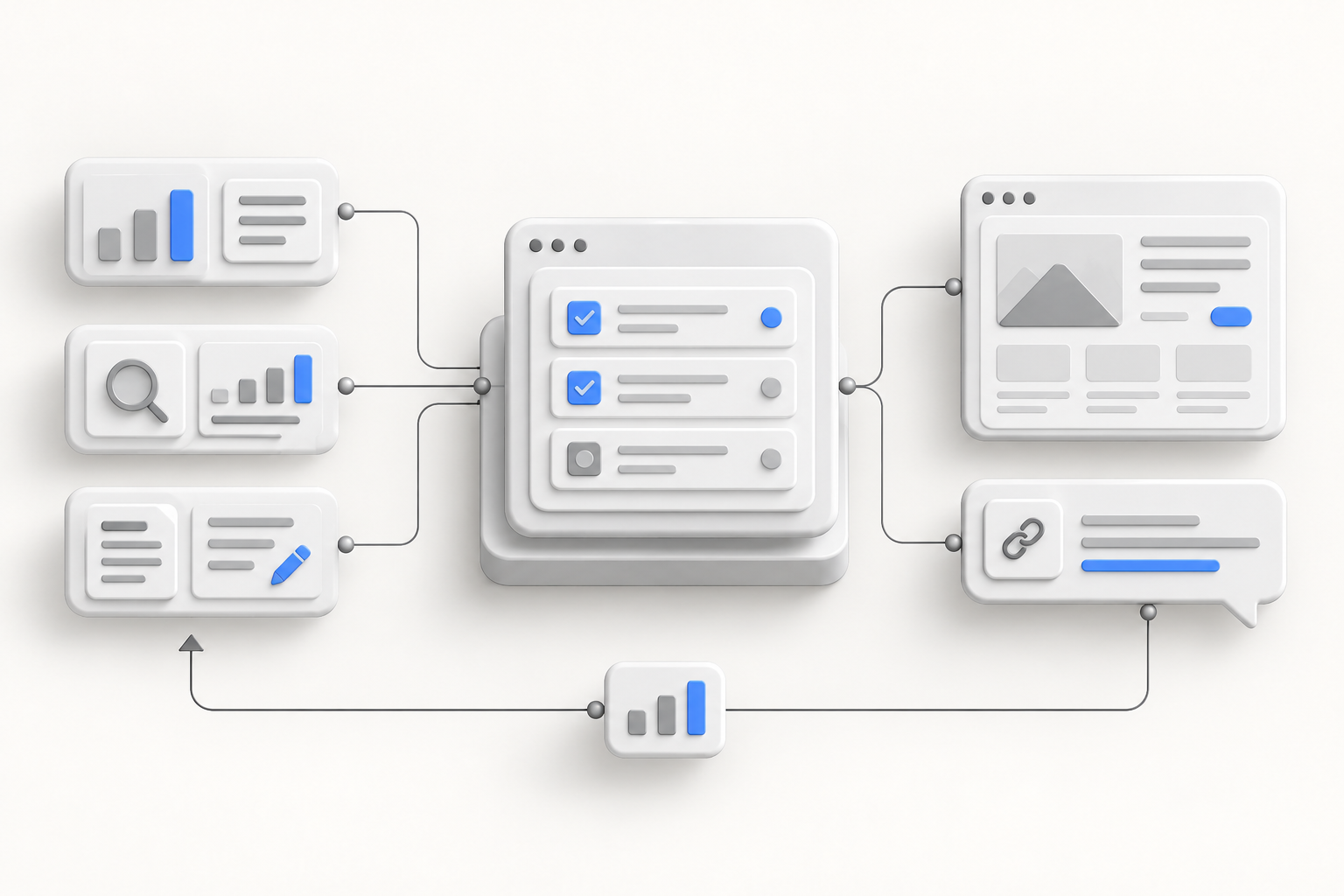
An AI visibility report can show that your brand is missing from an answer. The harder question is what to do next: investigate the source, correct product information, improve a comparison page, or gather better evidence before making a change.
Frevana's Agentic AEO uses AI agents to help brands improve AI visibility. We built the AEO team around a practical need: connecting research, analysis, technical review, and content work so that findings can become useful actions. Frevana's current product site lists an AEO Team among its Agent Apps. Explore Frevana's AEO Team.
This guide explains that approach and provides a workflow for evaluating AEO tools, prioritizing improvements, and measuring results. Frevana publishes this article; the examples below are suggested working methods, not guarantees of product capabilities or outcomes.
What Is Agentic AEO?
Answer engine optimization, or AEO, is the practice of improving how a brand's information can be discovered, understood, and represented in AI-generated answers. AI visibility describes the presence of that brand or its content in a defined set of observed answers.
Agentic AEO applies AI agents to parts of that work. A useful implementation connects a finding to a task, the evidence needed to complete it, and a reviewable result. The value depends on the work completed and its quality, not the number of agents involved.
For example, an observation that a buying guide omits installation requirements can become a specific task: check the approved manual, draft a compatibility section, and send it to the product owner for review.
Why Frevana Built an AEO Agent Team
The original launch article described a coordination problem: separate research, writing, analytics, and technical tools can leave marketers responsible for moving information between them. It proposed a team approach combining strategic, analytical, and content responsibilities.
That principle remains useful. A research finding should arrive with enough context for the next person or agent to act. A draft should retain its supporting evidence. A published improvement should have an owner and a way to review its effect.
Consider the difference between these two tasks:
- “Improve our AI visibility.” This leaves the audience, evidence, and deliverable undefined.
- “Review these ten buyer questions against our approved product specifications, identify missing answers on this page, and draft corrections with source references.” This produces a bounded result a team can evaluate.
The second brief is also easier to repeat, audit, and improve.
How AEO Tools and Agent Workflows Compare
Tool categories overlap. Use this comparison to identify responsibilities rather than assuming every product in a category has the same features.
| Approach | Main job | Useful output | What to check |
|---|---|---|---|
| Manual answer review | Investigate a small question set | Saved answers and a research log | Whether the process is consistent enough to repeat |
| AI visibility monitoring | Track observed mentions and sources | Answer history, citations, and trends | Exact engine coverage, collection method, and sample size |
| Technical SEO auditing | Find access and page-quality problems | Specific issues tied to URLs | Whether findings are actionable and relevant |
| Content assistance | Prepare explanations and revisions | Drafts based on approved evidence | Factual accuracy, usefulness, and editorial quality |
| Agentic AEO workflow | Connect research with follow-up work | Tasks, supporting evidence, reviewed deliverables | Supported actions, data access, handoffs, and review controls |
If your team already acts effectively on monitoring reports, another workflow layer may add little. If findings repeatedly stall between analytics and publishing, coordination is worth evaluating. Our guide to AEO tools for finding AI visibility gaps offers additional selection criteria.
A Five-Step Workflow for Improving AI Visibility
1. Choose a Buyer Decision, Then Define the Questions
Start with one product line or customer need. Use support tickets, sales conversations, and customer research to identify recurring questions. Separate observed customer language from questions generated for exploration.
For a desk-lamp brand, the initial set might include questions about desk size, power requirements, brightness controls, and replacement parts. A general question such as “What is the best lamp?” can be useful, but it should not be the entire research plan.
2. Save the Answers Before Interpreting the Score
Record the engine or interface, market, date, exact question, relevant conversation context, answer text, and any displayed links. Keep product recommendations separate from simple name mentions.
Inspect what the answer actually says. A missing mention is different from an incorrect specification, and a citation to your support page is different from a recommendation to buy your product. Each calls for a different response.
3. Turn Each Finding Into an Evidence-Based Task
Create a small backlog with one row per issue. Include the observed answer, affected page, approved source of truth, proposed change, owner, and review date.
Prioritize issues by their effect on the buyer's decision. Incorrect compatibility information deserves attention before a cosmetic wording change. If the correct answer is unknown, the task is to obtain evidence rather than generate a plausible claim.
4. Review and Publish Useful Improvements
Give the writing workflow approved specifications, documentation, and clear boundaries. Request a direct answer, supporting detail, and limitations where they matter. Have the responsible person check the draft before publication.
For your own website, technical accessibility and helpful content remain important. Google says its existing SEO guidance applies to AI Overviews and AI Mode; it does not require special AI files or special schema. Structured data should match visible content. These are Google-specific statements, not a universal formula for every assistant. Read Google Search Central's AI guidance.
5. Repeat the Observations and Log What Changed
After publishing, revisit the same question set over time. Keep dates and page changes alongside the collected answers. Avoid changing the engine, prompts, and scoring rules simultaneously if you want a meaningful comparison.
An improvement after a content update is an observation. It does not by itself prove that the update caused a recommendation. Look for repeated patterns and buyer outcomes before expanding the workflow.
Practical Example: A Product Answer That Needs Better Evidence
Imagine a lamp brand whose website says “ideal for any workspace,” while its manual lists a specific power adapter and desk-clamp thickness range. In a hypothetical answer review, shoppers receive vague installation guidance.
The team can turn this into a concrete project:
- Collect the relevant installation questions and save the observed answers.
- Confirm the current model's requirements with the product owner.
- Draft a page section covering power, mounting, included parts, and limitations.
- Check the draft against the manual and publish the approved change.
- Review later answers for factual accuracy and monitor related support questions.
The deliverable is a more useful explanation of the product. Improved AI representation is an outcome to measure, not a claim to make before collecting evidence.
Where Alexa for Shopping Fits
For e-commerce brands, include Amazon's Alexa for Shopping when it is relevant to the market and buying journey. Amazon describes conversational product research, comparisons, and personalized shopping assistance, with its announcement specifying U.S. availability. Personalization also means that two shoppers may not receive identical responses. Read Amazon's Alexa for Shopping announcement.
Ask an AEO tool provider to demonstrate the exact shopping surface it supports. Tracking another answer engine does not establish Amazon coverage. Record the product cards and links actually displayed rather than treating every interface as a conventional citation report.
Brands should focus on accurate information in the listing fields they control. Changes to their own site's markup do not change Amazon's technical infrastructure. See our Amazon AEO guide for Alexa for Shopping for a product-content checklist.
What to Ask Before Choosing AEO Tools
Use a real question and a real page during evaluation. Ask the provider to show the finding, its evidence, the resulting task, and how your team reviews the output.
- Which engines, markets, and interfaces does the tool actually observe?
- Can you inspect saved answers and source URLs behind a visibility score?
- Are research questions observed, inferred, or generated?
- Which actions are available in the selected workflow, and which require a person?
- Can drafts use approved facts and retain references to them?
- What permissions are required, and how are publication and account changes controlled?
- What usage limits, collection costs, and export options apply?
For Frevana, start with a scoped Agentic AEO task and confirm the current workflow against it. A demonstration is more useful than assuming an older launch description still represents every available action.
Measure Progress Without Confusing Visibility With Revenue
Choose metrics that match the job:
| Measure | Example definition | Interpretation |
|---|---|---|
| Mention rate | Answers naming the brand divided by sampled answers | Presence within that sample |
| Citation evidence | Saved URLs displayed with relevant answers | Which sources were referenced |
| Answer accuracy | Reviewed product statements matching approved facts | Quality of representation |
| Completed improvements | Approved fixes that are live | Work delivered, not search impact |
| Business outcomes | Identifiable referrals, inquiries, or purchases | Commercial results within available attribution |
If a brand appears in eight of 40 sampled answers, report a 20% mention rate for that sample. Do not describe it as 20% of the entire AI market. Report unidentifiable traffic and conversions honestly instead of assigning them to an assistant without evidence.
Frequently Asked Questions
Does Agentic AEO Replace SEO?
No. Keep maintaining your website's accessibility, content quality, and user experience. Agentic AEO adds a workflow for investigating generated answers and acting on relevant findings. It should complement the work that already helps customers discover and understand your business.
Can AEO Tools Guarantee AI Citations?
No. A tool can support research, monitoring, and content work, but it cannot promise how an independent answer engine will represent your brand. Ask for inspectable evidence and clear methodology instead of guaranteed placements.
What Makes an AEO Agent Team Useful?
Useful coordination carries context between tasks: the original question, observed answer, source facts, proposed improvement, and review status. Evaluate whether that reduces repeated work and improves deliverable quality for your team.
Do Small Brands Need Several AEO Tools?
Not necessarily. Start with a limited question set, a manual log, and one person responsible for acting on findings. Add tooling when a specific research, monitoring, or execution task becomes difficult to maintain. Our startup AEO guide explains how to prioritize a smaller budget.
How Does Frevana Help Brands Improve AI Visibility?
Frevana's Agentic AEO uses AI agents to help brands with AI visibility work. Evaluate the AEO Team against a defined deliverable, provide reliable product information, and agree on review and measurement steps. Explore Frevana.
How Quickly Should We Expect Results?
There is no universal timeline for discovery, citations, or recommendations. First measure whether the workflow produces accurate, useful changes. Then review answer patterns and identifiable customer outcomes over time.
Start With One Question Set and One Useful Change
Choose a buyer decision, save the answers you observe, and identify the most consequential information gap. Use AEO tools and an Agentic AEO workflow to turn that finding into a reviewed improvement. A repeatable process gives your team a stronger basis for its next decision than an isolated visibility score.